Stephen Darori is a Social Media Expert,Author, Publicist,Finance and Marketing Whiz , Strategist ,Journalist, Editor Prolific Blogger. Editor. You can follow Stephen Darori on Twitter, Facebook, Linkedin and other Social Media Platforms.
Stephen Darori & Associates has led major Social Media and Digital Campaigns for wide ranging clients that have included Hilary for America, the Democratic Party ,Democratic Alliance ( South Africa), Fortune 1000 companies and Shabbat.com
Showing posts with label @israelbookreview. Show all posts
Showing posts with label @israelbookreview. Show all posts
In the great marketing bake-off, social media takes the cake in terms of reach. With so many networks to choose from, and an audience of over 2 billion people, social media can be an effective platform on which all businesses can reach their target market. While that may be true, the reality is most B2B businesses struggle with how to incorporate social media into their marketing mix. To aid you, we’ve outlined several B2B social media tips below.
Before we dig into best practices, let’s look at how B2B companies are using social media?
Market research. Listen online, and find out what prospects and customers are saying about your brand. What do they want from your product?
Brand awareness. Expand what people know about you, and increase your reach. A strong online presence can bring you greater exposure.
Thought leadership. Position yourself as an authority in your industry by sharing your thoughts on social media.
Account-based marketing. Reach employees of target companies with ad campaigns specific to their company.
Hiring & recruiting. Use social media as a platform to attract potential employees.
Relationship building. Connect and build rapport with your customers through social media.
Lead generation. Identify and forge relationships with potential customers online.
Social selling. Sales teams can leverage their social networks to target prospects and drive sales.
Now that you know how B2B companies can use social, lets look at how can you build the best social strategy for your business. Check out these B2B social media tips to enhance your brand’s presence online:
Awareness. Make sure you have buy-in across the organization. Start with the CEO and work outwards making sure to manage expectations and find employees who shine on social.
Adoption. Make social a cross-departmental effort. Reach beyond Marketing, and get Sales, HR, Recruiting, and Customer Service involved.
Analysis. Use social data to your advantage, and gain valuable insights to see what content and posts perform best on social.
Accolades. Share all wins, regardless of size. Tell your stories on social to humanize your brand and connect with your customers.
While B2B marketers tend to be hyper-focused on led gen, it’s important to remember that social media is a great tool for relationship-building that can help your business gain traction and credibility with specific audiences.
To do it effectively, social media should be a company-wide endeavor, with everyone involved and actively contributing. Sometimes people think they have nothing to offer. Make it easy for them to distribute engaging content on their own social media networks by providing relevant company updates and news.
The key to increasing your digital footprint, brand awareness, and generating trust, is simple. Get your team to engage in conversations. This humanizes the brand, helps give the brand a personality, and gives a boost to any paid campaigns you are running.
Here are five B2B companies that are embracing these B2B social media tips and are excelling on social media:
GE
GE makes specific engineering topics feel relevant to their audience with interesting content like this video, which shows how 3D printing can be used for medical purposes. Through content like this, GE is able to spark interest and highlight how their products are applicable in other fields.
American Express
American Express uses social media to get feedback and input from customers. For example, they will create polls on Twitter like the one below to engage their audience and better understand their motivation.
Cisco likes to focus on current events. For example, for April Fool’s Day they posted an April Fool’s Day inspired post on Instagram. Similarly, during March Madness they posted their CEO’s bracket on Instagram. By utilizing this type of content Cisco has been able to have engaging conversations with its audience and, at the same time, make its brand more relatable.
Cisco April Fool’s Day Instagram post
Cisco March Madness Instagram post
Intel
Intel leverages its social media for recruiting by showcasing the company’s culture and highlighting how its employees are changing the world.
Novartis
Novartis uses its Instagram to showcase employee volunteerism in the community, which promotes its brand and builds a positive image of the company.
Conducting a social media audit is a key part of a social media marketing plan. This assesses how well your current social media use works for you.
There are a number of different steps involved in this process, so we have put together a social media audit template to help you conduct your first (or second, or third…) one more efficiently.
What is a social media audit?
A social media audit is a regular examination of social channels that represent your brand—including both your business’ owned profiles and imposter accounts.
The purpose is to ensure that each of your profiles are on brand and functioning correctly, identify and shut down any rogue or abandoned accounts, and ensure that you’re using the channels that make the most sense for your brand.
A 6-step guide to conducting a social media audit
Step 1: Create a social media audit spreadsheet
Your social media audit needs a home, which is why you need a spreadsheet. As you go through these six steps, you’ll see that the spreadsheet will start automatically adding new columns.
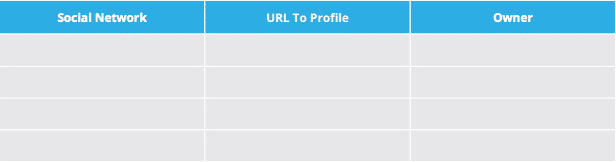
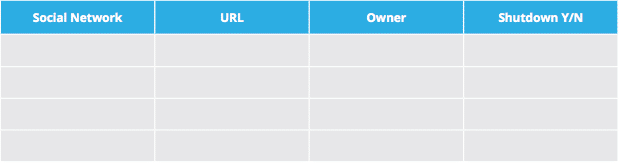
To start, create a column for each social network, URL to your profile on that social network, and owner. The “Owner” field may seem superfluous, but it’s actually really important to keep track of this information—it allows you to know who owns the password and who is in charge of posting and engaging with followers on that social profile.
Step 2: Go on a search for your social presence on Google
Go to Google and search your company name to see which social media profiles show up. This will allow you to see if there are any rogue accounts or imposters using your company name. It also gives you the opportunity to find out if the right social media profiles are appearing on in search results.
You can either create a separate spreadsheet to track the results of this search, or add a new column—labelled “Shutdown Y/N”—in the original spreadsheet. The purpose of this is to keep track of whether you need to track down an imposter to tell them to shut down their account, or contact the social network to ask them to intervene in the matter.
Step 3: Evaluate your social media profiles
This is an important part of your social media audit. As with your social media marketing plan, you need to constantly be evaluating your social media profiles.
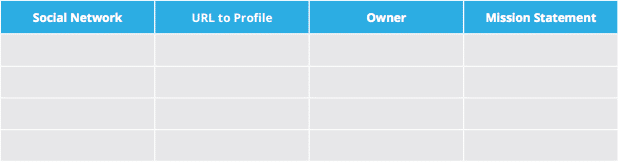
During the evaluation process, create a mission statement for each profile. Make sure each profile aligns with your business goals and objectives. This will help you decide whether being present on that social network contributes to your overall strategy and whether or not it makes sense for your business to keep that profile.
Step 4: Make sure your social media profiles are on brand
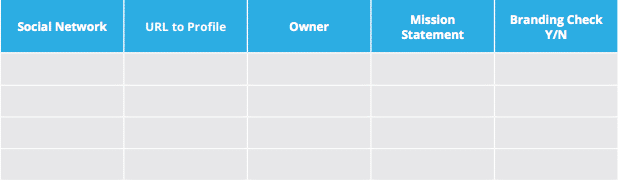
Now that you know which social media profiles you’re going to keep, it’s time to check that each of these profiles meet your brand standards for imagery, style, etc.
This means making sure you have a proper profile photo, cover image, icons, bios and descriptions, correct URL, etc.
Step 5: Centralize the ownership of your passwords
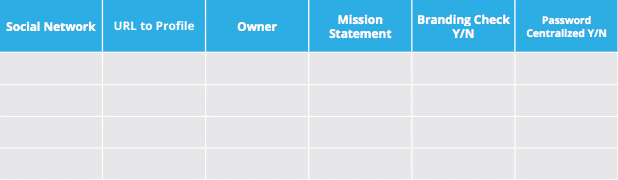
The process of doing a social media audit can help you make sure that all your social media profiles are secure. One way to test this is by centralizing the ownership of the passwords for each profile. For example: you can have your IT department own the key to all the passwords for the social media profiles. Then use a password managing tool like LastPass to share access on a need-to-use basis.
Step 6: Create a process
Once you’re done your social media audit, it’s time to take what you learned and create an internal process when it comes to creating new social profiles going forward. Create a criteria and take note of who will approve the requests.
For example, take note of:
The requester
Who the target audience is
What type of content will be posted to this profile
Who is responsible for posting and engagement
Use the information you’ve discovered through your social media marketing audit to build a more robust social media strategy. Then, put it to work using Hootsuite to schedule posts, engage with followers, and monitor your efforts.
Spending under half an hour a day managing social media may sound like a tall order, especially considering that an average user spends approximately two hours per day on social. But if you’re in charge of multiple marketing activities for your company, you may not have that much time on your hands to dedicate to social.
Let’s say you’ve only got a measly 18 minutes—it’s going to be tight, but we’ve got a plan we think can work for you.
In this guide we will go over how to maximize your time on social using Hootsuite and stay laser focused on your daily objectives. 18-minute-a-day social media plan 8 minutes: Listen
Social listening is about catching the conversations happening around your brand. It allows you to improve your customer service, get customer feedback, learn more about your competitors, and find new leads. It’s an essential part of your daily routine.
Where do you start? You can track keywords, hashtags, mentions, and messages for your brand and competitors. In Hootsuite, you can set up specific streams for your social networks.
Learn how to get even more out of Hootsuite with free social media training from Hootsuite Academy. Here’s what you should take note of each day: Mentions of your brand or product. Scroll through keyword and hashtag streams related to the products and services you offer. Reply to all comments and queries that come up around your brand. With Hootsuite, you can create templates for your most common responses to save time when engaging with people. Pre-composed responses are great if you’re running a busy contest or campaign, but they shouldn’t replace day-to-day interaction with customers. Purchase intent. Fewer than three percent of customers directly “@” mention a brand on Twitter, so make sure that your search streams target purchase intent moments. What does “purchase intent moments” mean? Instead of only listing your brand keywords in streams, for example, list words that customers might use when they’re looking for a solution that your company solves or they’re evaluating your product. For example, a hotel brand could target and engage with consumers getting ready for a last-minute vacation by setting up search streams for specific destinations and keywords such as “travel” and “vacation.” Industry news and updates. In your streams, follow trending hashtags, industry keywords, Twitter chats, and relevant people to make sure you’re on top of the latest news. You can also set up RSS feeds in Hootsuite.
Pro tip: You can geo-target your searches if you’re looking for customers or conversations in a certain location. Master geo-targeting in our free Hootsuite Academy course (go to module 2.3).
Bonus: Download a free guide to discover how to get more sales and conversions with social media monitoring on Hootsuite—no tricks or boring tips.
5 minutes: Engage
For brands on social, engagement is key. According to a study by Edelman, nine out of 10 customers say they want to have meaningful interactions with brands on social media, yet fewer than one in five believe that brands actually deliver. There’s a lot of room for improvement.
If you’re set up for effective social listening, then reaching out to your audience on a day-to-day basis should be fairly straightforward. You can quickly filter through the chatter and make sure you’re engaging with customers, influencers, and relevant content. Here’s what you should focus on: Replying (remember, you can create pre-composed responses) Liking and commenting on tagged content Following back relevant followers (such as influencers and thought leaders) Reposting user generated content 2 minutes: Analyze
In order to develop an efficient content plan, you need to know what content performs best on your social networks. To do that, you can use analytics tools that show you the performance of multiple social networks.
Hootsuite Analytics gives you a clear snapshot of your Twitter, Facebook, and Instagram performance with a comprehensive overview, which lets you monitor campaigns, identify trends, and track follower growth. You should check in once a day to track activity and generate reports over a timeline that makes sense for you.
When you don’t have time to revisit your social channels multiple times a day, scheduling is an absolutely essential part of your daily routine. If you’re scheduling across multiple channels, use different content for each one. Save time by using a tool like UpContent, available in the Hootsuite App Directory, to help you find quality content to share.
Here’s what you should think about on each network:
On Facebook, you can tell longer stories and use visually rich messaging. Limit your posts to once or twice per day.
On Twitter, if you schedule Tweets, make sure to space them out to avoid being perceived as “spamming” your audience. Include Tweets with different formats—switch up photos, video, and link placement—to test which ones perform best. If you are sharing content from an external source, include the appropriate hashtags and @mentions.
On LinkedIn, share content with a more serious tone, oriented to a professional audience, through LinkedIn’s publishing platform. It’s an excellent place to share thought leadership from an executive in your company.
On Instagram, if you have a campaign or a product release coming up, schedule a photo or video to spread awareness. Instagram also presents a great opportunity to give your customers an exclusive behind-the-scenes look at your business and the people who run it.
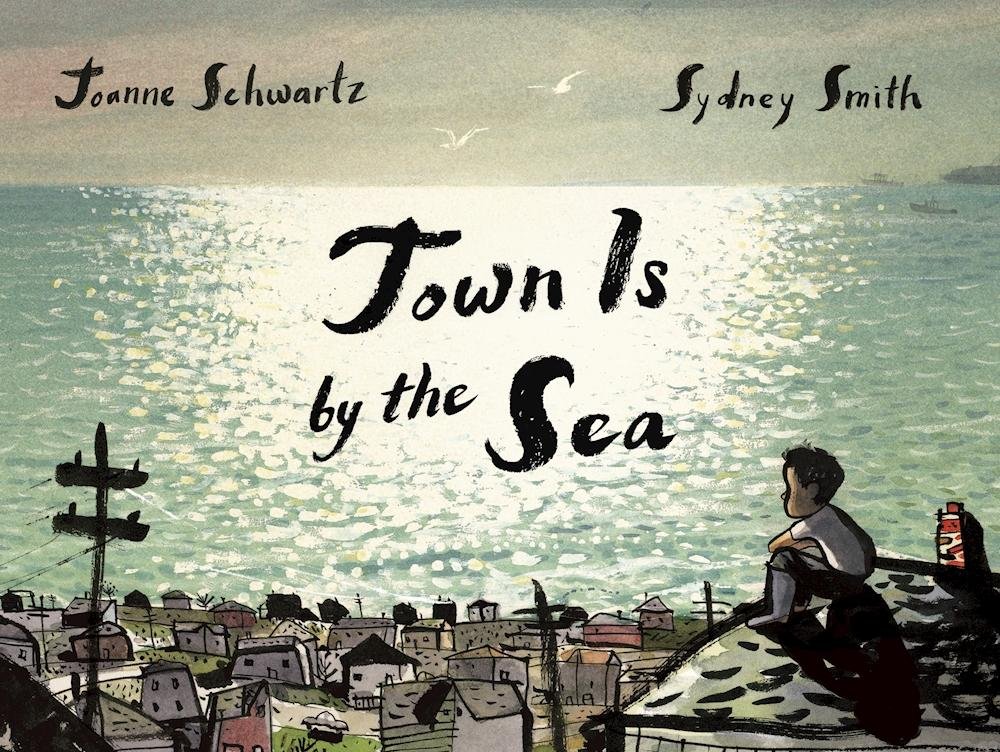
Written by Joanne Schwartz and delightfully illustrated by Sydney Smith , Town is by the Sea is a quiet book that will stay with readers long after they have closed it. (Picture book. 5-8)
The coal mines of Cape Breton in the Canadian province of Nova Scotia have closed, but this book recalls a time when generations of men toiled in the mines under the sea.
As the book starts, a white couple stands by the door. The woman holds her husband’s lunch pail as he gets ready to leave home. Upstairs, their son wakes up, and it is from him that readers will get to know his town and life by the sea, the repeated phrase “it goes like this—” lending the narrative a timeless quality. Both the text and the illustrations have a simple, understated quality that go hand in hand and lend a melancholic feel to the whole. A muted palette and images heavily outlined in black reinforce the feeling. As the boy goes about his life above—playing with his brown-skinned friend; coming home to a simple lunch; going to the store with a list for the grocer; or visiting his grandfather’s grave overlooking the sea—several predominantly black two-page spreads, vigorously textured strokes of black and gray adding weight, are woven into the narrative, reminding readers that deep down, the miners are digging for coal. A particularly poignant spread depicts the front door of the house in a wordless series, the angle of the sunlight showing time going by; in the last image the door is opening, and the narrator’s father is home at last.
You probably know that word-of-mouth is one of the most valuable forms of marketing out there: It’s been shown to influence20 to 50 percent of all purchasing decisions. After all, potential customers are much more likely to be receptive to recommendations from a person they respect and trust than to ads or other corporate messaging.
In the new world of digital relationships, word of mouth extends well beyond recommendations from friends and family into the realm of influencer marketing.
In fact, research from Twitter shows that 49 percent of consumers seek purchase guidance from social media influencers, and 20 percent said that a Tweet from an influencer inspired them to share their own product recommendation. Even more important for marketers, nearly 40 percent of Twitter users said they had made a purchase as a direct result of an influencer’s Tweet.
In this post we’ll take you through everything you need to know about influencer marketing—from strategy and tips, to tools you can use to boost your campaign.
An influencer is quite simply someone who carries influence over others. A social media influencer is someone who wields that influence through social media. The form of influence can vary and no two influencers are the same. Celebrity endorsements were the original form of influencer marketing, but in the digital age of online connection, regular people have become online “celebrities” with powerfully engaged social media followings, especially in certain market segments.
In fact, a survey of U.S. teens conducted for Variety last year found that YouTube creators took eight of the top 10 spots in a survey of influencers, outranking traditional celebrities like musicians and movie stars.
Perhaps no one embodies the concept of the social media influencer more than DJ Khaled, whom The Washington Post dubbed “The King of Snapchat.” His 6 million Snapchat followers make him an obvious choice for brands who may not (yet) have a strong Snapchat presence of their own.
How to incorporate influencer marketing in your social media strategy
Think of influencer marketing as simply another arrow in your marketing quiver. While it’s a different approach to brand messaging, your influencer campaigns should still align with your larger content strategy and brand image so that they enhance your overall brand reputation.
Extend your reach (or laser-target your message) through influencer channels
In many cases, you will use influencer marketing to extend the reach of your brand messaging by working with social media influencers to create or support content they post on their own social media channels. This allows you to piggyback on someone else’s follower base, either to reach a broader audience or to segment your efforts in ways that would never be possible through your own branded social media accounts.
For example, the National Pork Board has partnered with Latino social media influencers in its #sabrososmomentos campaign to encourage Hispanic American families to serve more pork at family get-togethers throughout the holiday season, targeting a specific segment it would be challenging to reach through the board’s own branded channels.
This video, posted by influencers Los Pichy Boys on October 18, already has more than 340,000 views.
Boost credibility with influencer messaging on your own channels
You can also recruit influencers to participate in content that you share or cross-post on your own channels, as clothing company ThreadBeast did when it created a series of Facebook Ads with streetwear influencers like Nightwing2303 unboxing ThreadBeast packages.
Check out the views on that Facebook video: 3.4 million! Plus, it garnered another 200,000 views on Nightwing2303’s YouTube channel. The campaign targeted 18- to 24-year-old men in the U.S. with an interest in hip-hop or streetwear brands, and resulted in a 36 percent increase in clickthrough rate.
ThreadBeast’s Facebook ads influencer campaign ended in July, but the company is still working with influencers: Nightwing2303 posted a new unboxing video to YouTube earlier this month. A social media takeover, like the DJ Khaled example above, is another effective way to leverage an influencer’s following and cross-promote your own channels to build up your own follower base.
How to find the right social media influencer for your campaign
Before reaching out to a potential social media influencer, you’ll need to consider the Rs of influence:
Relevance: The influencer is sharing content and developing a following relevant to your business and the particular market segment you want to target.
Reach: The number of people you could potentially reach through the influencer’s follower base that would bring value to your business.
Resonance: The potential level of engagement the influencer can create with an audience that’s valuable and relevant to your brand.
When determining whether an influencer is a good match for your three Rs, you’ll need to ask yourself a couple of important questions.
Who are you trying to influence?
Most marketers have no trouble coming up with a high-level answer to this question: you’re trying to influence your customers, prospects, and the broader industry community. But your influencer campaign can’t be all things to all people: as in all types of marketing strategy, a meaningful answer requires greater focus and a clear understanding of your goals and your audience.
Perhaps you’re trying to influence people who work in a specific job function—social media professionals or community managers who tend to spend significant amounts of time on social media every day, for example. Or maybe your goal is to influence decision-makers in a particular vertical—maybe government or finance leaders who tend to place deep trust in recommendations from their peer network. Or, you could be trying to target a specific consumer segment, like millennials looking to buy their first home.
These are three very different groups, and an effective influencer marketing strategy requires you to speak to the right people using the right tools (and, in this case, the right influencers), just like you do in all of your other marketing work.
Looking at a very specific marketing niche, for example, a recent survey from public relations firm MWWPR found that influencer marketing is the most effective way of marketing spirits to millennials, along with earned media. According to the report, 54 percent of Millennials share branded content from spirits companies when it is posted by a social influencer, and 93 percent usually try a new liquor after someone recommends it to them. For any liquor brand looking to expand into the millennial market, those numbers should be hard to ignore.
Who do your customers, prospects, and community trust?
For marketers, the key requirement for true influence is trust. Your audience must trust and respect the opinion of the influencers you partner with. Without the trust component, any lift in results will be superficial and you’ll struggle to see a tangible business impact from your efforts.
Working from a clear idea of exactly who you’re trying to influence, take the extra step to find key opinion and thought leaders whom your audience already looks to as sources of meaningful information. These people are already influencers—and partnerships with them can drive real impact.
Keep in mind that your audience demographics play a major role in determining which influencers will be the most trusted in your marketplace. Data from Twitter shows that people aged 45 and up view more traditional household name celebrities as preferred influencers, while millennials prefer digital content creators.
Targeting that millennial market, Contiki has been using influencer marketing for five years through its #RoadTrip series, hosting groups of YouTube stars as they follow Contiki itineraries around the world. Some videos, like the one below created by influencers Jesse and Jeana (BFvsGF), racked up more than a million views (not to mention more than 125,000 likes).
Perhaps it’s no surprise, then, that after its 2015 RoadTrip to Southeast Asia, Contiki saw a 175 percent increase in owned YouTube audience and a 25 percent increase in traffic to its Asian trip packages online. Anecdotally, when Contiki’s Canadian sales managers visited various campuses across the country, they heard from at least one person each day who mentioned they had first learned about the travel brand through their favorite YouTuber. The campaign helped Contiki win the Skifties award for Best Travel Brand on YouTube and the British Youth Travel Award for Best Use of Social Media.
There are plenty of tools to help you identify people with large and engaged networks talking about topics that matter to your audience, including followerwonk, Traackr, Klout, and Hootsuite. But remember that reach alone does not indicate a powerful influencer—you also need the other two Rs: relevance and resonance. Watch for engaged followers—that means plenty of views, likes, comments, and shares, all from the precise follower segments you’re trying to reach.
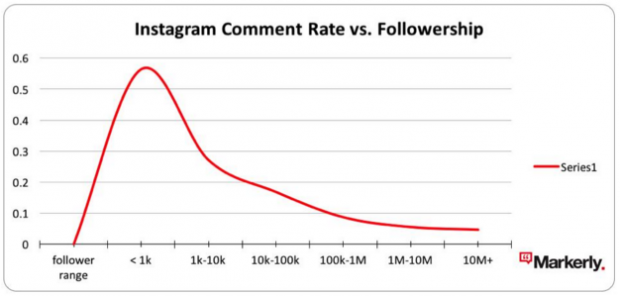
A huge follower count is meaningless without evidence that those followers are paying attention, and a smaller follower count can be very powerful if it’s a niche area and the potential influencer is a recognized leader. Markerly, a network that connects brands with influencers, recently found that partnering with “micro-influencers” can provide much better ROI than trying to snag a big celebrity. Their analysis of 800,000 Instagram users found that the influencers with 10,000 to 100,000 followers offer the best combination of resonance and reach.
Influencers are becoming increasingly important in the social media world, and they expect to be recognized for the value they bring to your brand. Here are some key ways to ensure you build influencer relationships that are beneficial over the long term.
Reach out slowly
Once you identify a social media influencer you want to engage with, start the connection process by reaching out through content they are already sharing, and conversations they are already starting or leading. Twitter chats are a great way to do this. If you know your potential social media influencer is hosting a Twitter chat, be sure to mark the date and participate. If they have a blog, comment on their blog posts to show that you are actually reading their content.
Once you’ve begun to build rapport, the relationship can bloom into a mutually beneficial one. On that note…
Create mutual value
As a marketer, you’re probably focused on the value that influencers can provide to your brand, not the other way around. But to create a meaningful and lasting relationship, influencers must also derive value from partnering with your brand—and not just in the form of cold, hard cash (although that always helps).
“Value” doesn’t only mean financial compensation; it simply means that the perceived benefit of the partnership is equally important to both you and the influencer. It could involve a content swap, an introduction to a unique community, or some kind of swag or product placement, but always keep in mind that mutual value will be the key driver of long-term influencer relationships.
Go for a consistent look, feel, and tone
When choosing an influencer, in addition to finding a fit for your niche market, you need to find someone who’s producing content with a similar look and feel to your own, and whose tone is appropriate for the way you want to present your brand to potential customers. This will make it much easier for the brand and the influencer to share, swap, and collaborate without creating a disjointed feel in either party’s social media posts.
A social media influencer who has worked hard to build a following will not accept a deal that makes their own personal brand seem inconsistent. And allowing the influencer creative freedom is much easier when you know that their content will gel with your own. Combining your efforts creates the best results—data from Twitter shows that exposure to a brand Tweet creates a 2.7 times lift in purchase intent, but exposure to both a brand Tweet and an influencer Tweet more than doubles that lift to 5.2 times.
Measure the results
Social media influencers should be able to provide analytics and detailed reports on the reach of their posts, but remember that you’re also looking to track engagement. This can be tricky, with 47 percent of respondents to a recent survey saying that proving the value of their influencer marketing campaigns is their biggest measurement challenge. Hootsuite allows you to measure campaign success by tracking mentions of the brand or campaign hashtags with social listening streams. Remember that influencer marketing is one of the hottest online marketing trends right now, but you still need to do your research, ensure your efforts align with your overall marketing strategy, and test and track your results to improve performance, just as you would with any other marketing tool.
10 influencer marketing tools
A list of influencer marketing tools to help you find influential people to partner with, and track the success of your campaigns.
Stop chasing online personalities that have little sway over your target audience. This template will help you map out your influencer marketing strategy and inform partner decisions.
This tool by Moz makes it easy to find relevant influencers on Twitter by topic and location. Use it to build a list of potential influencers to engage and partner with. Pro tip:create a Twitter list for these individuals for easy reference.
You can use Hootsuite search streams to discover social media influencers by monitoring conversations relevant to your industry. Who is your target audience engaging with? Whose content are they sharing? These people have clout that can help your brand expand it’s reach.
Once you have a set of influencers to follow, you can add them to a Twitter list and save it as a stream to easily track what they share and who they engage with—learn from the best.
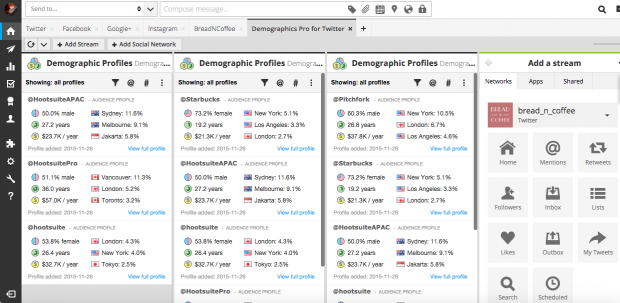
Use this tool to determine whether an influencer’s audience is right for your brand. The app will give you relevant data on a user’s following, including average age, income, location, likes, interests, and profession.
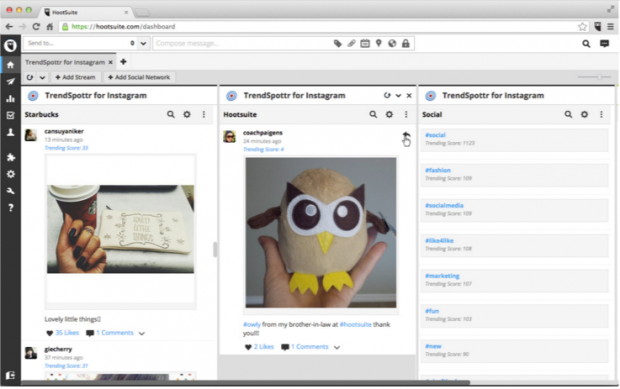
Find the top trending photos, videos, and influencers for any tag or topic with TrendSpottr for Instagram. The app also makes it easy to engage with key influencers, view trending hashtags, select from a list of popular tags, and easily share trending posts to your social networks.
Find local Instagram influencers posting in your area (or an area you choose to follow). You can monitor for locations and hashtags, or combine search terms for advanced listening.
These short text codes can be added to a URL to track important data about website visitors and traffic sources. Create them for your influencers to use when they share content on social media so you can track how much engagement the campaign is receiving.
Use the Hootsuite dashboard to create UTM parameters in a few simple steps. Then you can share the links with your social media influencer or easily add it to your posts.
As we explain in our post, The Facebook Pixel: What It Is and How to Use It, this tool makes it easy to track conversions from a Facebook ad, optimize ads based on data collected, build targeted audiences for future ads, and remarket to qualified leads (people who have already taken some kind of action on your website).
If your influencer marketing strategy includes a Facebook ad component, you can use a pixel’s remarketing capabilities to expand an influencer’s reach and connect with a new and relevant audience. Check out our step-by-step guide to learn how to put the tactic to work in your next campaign.
This app identifies and ranks industry influencers and uses their inherent trust to discover content relevant to your audience. This makes it easy for you to find and share content that will help expand your businesses’ reach on social media.
Do your busy @mention streams make it more difficult to engage with influencers? InsightPool’s single-click response interface makes it easy to cut through the noise and connect with key individuals.


 Cisco April Fool’s Day Instagram post





 It’s going down on Snapchat
  : VisitLasVegas