Showing posts with label Instagram. Show all posts

Saturday, February 25, 2017

Lessons Brands Can Learn from the Most Creative Accounts on Instagram

With 500 million active users, it can be hard to stand out from the crowd on Instagram. It just isn’t enough anymore to create your account, post beautiful pictures every now and then, and like a few photos. Brands, influencers, and the everyday Instagrammer are stepping outside the 1080px by 1080px square box and pushing the boundaries on creativity. If you really want your account to stand out from the brunch pics, selfies, and photos of feet, you need to think creatively.

As a way of surfacing the best Instagram campaigns, the Hootsuite social team created a curated account called Hootsuite Showcase. Featuring uniquely awesome accounts or campaigns on Instagram, it is a resource for inspiration and an easy way to see what others are doing on the platform. Each account or campaign featured on the showcase has been chosen for a specific reason, but they all share one thing in common: exceptional creativity. Viewed as a ‘Best of Instagram,’ there are plenty of lessons that can be learned from content featured on the Hootsuite Showcase1. Aim for consistency of imagery and theme
 Find MoMo by @Andrewknapp
Creating (and sticking to) an Instagram theme isn’t the easiest thing to do, but taking that extra time to nail-down your signature style goes a long way. Whether it’s focusing on a theme or using the same filter (or editing technique) for all your photos, having consistency will take out the guessing game and keep people coming back.
One of my favorite examples is Canadian designer, photographer and Instagrammer Andrew Knapp, who is particularly fond of hide-and-seek. Knapp takes creative photos in which his border collie Momo is hidden among buildings, crowds, or breathtaking landscapes, giving followers the chance to play Where’s Waldo with the playful pup. The Instagram photos are beautiful and it’s surprisingly challenging to find Momo. Knapp’s photos are consistent in lighting and color, and I truly look forward to seeing his photos in my feed and searching for Momo.

Lesson No. 2: Utilize Instagram’s grid layout to help customers

#EndlessTable by @reynoldskitchens
7 Lessons Brands Can Learn from Instagram’s Most Creative Accounts | Hootsuite Blog
Image via Reynolds Kitchen on Instagram.
Any Instagram user with a little bit of game knows that part of the platform’s appeal is its clean, grid-style design. If you visit any user’s profile, you’ll see their images laid out in a grid with three images across. But have you ever thought about using Instagram’s grid layout in your strategy? It takes a lot of planning, designing, and detailing, but when done correctly it can make a real impact. Reynolds Kitchens are experts at this, and tapped into a huge #foodie fan base. I mean, who doesn’t love hearty comfort foods?
Working with creative agency Havas Worldwide Chicago they created a social campaign that is sure to inspire hunger pangs. The amazingness that is the #EndlessTable consists of one giant table split into dozens of separate images by utilizing Instagram’s grid layout. Each image features a scrumptious recipes for every occasion and season (notice the Thanksgiving and Halloween treats!).
When you click on an image like the sweet potato and kale salad, it forwards you to another Instagram account that consists exclusively of the ingredients needed to make that dish, as well as instructions and a link to Reynolds Kitchens’ website.
In addition to making me want to put on an apron and start baking, this interactive campaign is an awesome example of a brand using Instagram’s grid layout to ignite awareness, share content, and increase customer engagement.
While making full use of Instagram’s grid layout is a great way to up your account’s creativity, you have to be careful.

Lesson No. 2.5: Don’t “clog the feed”

Art installation by @asvpxrocky
7 Lessons Brands Can Learn from Instagram’s Most Creative Accounts | Hootsuite Blog
Image via A$AP Rocky on Instagram.
Rapper A$AP Rocky posted an art installation on Instagram that comprised 168 individual frames of imagery, done in coordination with Art Director Robert Gallardo. Posted in May 2015, all 168 images were published on the same day, to the chagrin of the 100,000 followers that stopped following the account.
While the attention the project garnered was mostly positive, brands should be aware of the potential backlash of posting massive collages as this barrage of images can “clog the feed.” On Hootsuite Showcase, we try and stick to between nine and 15 images in order to avoid overwhelming our follower’s feeds.

Lesson No. 3: Engage your audience with interactive contests

Heineken scavenger hunt by @crack_the_us_open
7 Lessons Brands Can Learn from Instagram’s Most Creative Accounts | Hootsuite Blog
Image via Heineken’s crack_the_us_open on Instagram.
It’s no surprise that contests on Instagram create engaging moments. When deciding what type of contest you want to run, an interactive approach using Instagram’s grid layout is something to consider. To move beyond asking followers to comment or like for a chance to win, try creating a scavenger hunt, similar to what Heineken did in 2013. They created an Instagram account called @crack_the_us_open for their sponsorship of the U.S. Open Tennis Championships. The account, created in part by ad agency Wieden+Kennedy, served as a hand-held scavenger hunt, rewarding players with a chance to win tickets to the tournament.
The account featured an extreme panorama image of a crowd watching tennis, split into square pieces to utilize Instagram’s profile grid layout. In each individual photo, Heineken provided clues in the image captions. Instagram users had to scan the crowd and hashtag the correct images. In order to play, users had to turn their phones 90 degrees to view the panoramic image of fans utilizing Instagram’s grid layout.

Lesson No. 4: Make the most of user generated content through unbranded hashtags

The struggle to create fresh and engaging content for your audience is real. You’ve worked hard to create an engaged following, so why not tap into that community? User generated content is an opportunity for you to let go of the reins and leave it in the hands of your awesome supporters.
One way to launch a user generated campaign is to create an unbranded hashtag. An unbranded hashtag can be beneficial because it’s less promotional, giving it a greater chance to spread and (hopefully) go viral. The hashtag must be creative, clever, and, most importantly, NOT have your brand name in it. Two brands that did a great job at running a user generated campaign on Instagram are Polerstuff and Kit and Ace.
#BeneathTheBrim by @polerstuff
Polerstuff is a outdoor gear and sporting goods brand that created the hashtag #beneaththebrim to encourage fans to share photos from “beneath the brim” of their Poler hats. Often framing beautiful landscapes, the images are immediately recognizable by the “CAMP VIBES” text on the underside of each hat.
Thousands of fans shared stunning images with tasteful product placement. Poler uses this hashtag to great effect, often sharing images tagged with #beneaththebrim through their official Instagram account. This cache of user generated content provides an avenue for fans to creatively engage with the brand.
#ThisTimeIsPrecious by @kitandace
Kit and Ace is a Vancouver retail company making waves on social and growing their following through user generated content campaigns and influencer marketing. Their campaign, #thistimeisprecious, sparked our attention as it encouraged people to share what means most to them over the holiday season. From loved ones to locations, and activities to traditions, people took to Instagram to share what’s precious to them.
The campaign, which included customers, employees and influencers, gave Kit and Ace the opportunity to demonstrate the power of user generated content and how it can grow a community of supporters. In addition, working with influencers in many different cities has grown their credibility as a brand by showcasing support from industry professionals.

Lesson No. 5: Try out #TBT for education

Company history #tbts by @generalelectric
What did social media do before throwback Thursday? Once a week, the internet is flooded with baby pics and family portraits that can prove far more divisive than expected. Love it or hate it, throwback Thursday is here to stay. Instead of jumping on the baby pictures bandwagon, why not use this viral hashtag to build awareness about your company or educate your followers about the evolution of your product.
An awesome example of this is the way General Electric innovatively used #tbt to educate followers on the life of their company. GE created custom videos and images that provided insight into both the history of the 123-year-old brand, and science in general. This method is a great way for non-visual brands to share through Instagram. Companies that aren’t consistently creating new visuals can mine photo archives for engaging images—giving them the opportunity to share new content and tell followers about their company’s history.

Lesson No. 6: Use Instagram for recruitment

#CastMeMarc by @marcjacobs
Forget the traditional resume! Okay, maybe not altogether, but there is so much opportunity to use social to find the next brilliant mind to join your team. Of course, there are limits to this, as you don’t want to expose those applying for another position, but playing around with incorporating social into your recruitment process can reveal some incredible talent.
Marc Jacobs created the hashtag #castmemarc as a casting call to recruit modeling talent and increase brand awareness on Instagram. Users tagged images of themselves or their friends for a chance to be scouted by the Marc Jacobs team and appear in upcoming fashion campaigns. With over 119,000 uses of the hashtag on Instagram, the campaign has been a massive social media success.

Lesson No. 7: Ask your dog to be an influencer

Aspen the Mountain Pup by @aspenthemountainpup
His exploration of mountain tops and vast glacier lakes in the U.S. and Canada give us major adventure and travel envy. No stranger to adoring fans, Aspen has a large following of 152,000 and has sparked the interest of many companies like Michelob Ultra, Original Penguin, and Expedia who worked with him to create cool campaigns and contests. When he’s not canoeing, hiking, camping, and playing in snow, he’s cuddling up with his owners Hunter Lawrence (not only his dad but an experienced photographer as you can see) and Sarah Lawrence (his mom and lifestyle blogger).

Wednesday, February 22, 2017

Reasons Celebrities Are Better at Instagram Than Brands


The 25 most-followed accounts on Instagram are, more or less, what you’d expect. There are quite a few familiar faces: Selena Gomez, Taylor Swift, Beyonce Knowles, Justin Bieber, Katy Perry—the list goes on.

And, of course, the ubiquitous Kardashian-Jenners make a good showing. The alliterative sisters Kim, Kylie, Kendall, Khloe, and Kourtney all rank within the top 20.

It’s hard to deny that celebs—the Kardashian-Jenners in particular—are good at social.

But why is that?

There are a few things that they get about Instagram that brands just don’t.

Bonus: Download a free checklist that reveals the exact steps an adventure photographer used to grow from 0 to 110,000 followers on Instagram with no budget and no expensive gear. Plus we’ll show you how you can use Hootsuite to grow your own following on Instagram and other platforms.

1. They get internet humor


The internet is a vast place, full of disparate people voicing a cacophony of opinions. There’s very little that can typically be attributed to the culture of the internet as a whole.

Except maybe humor.

The internet at large, and social media in particular, are home to a particular sense of humor—a unique constellation of memes, clever hashtags, puns, mixed with a healthy dose of nostalgia. Add in a dollop of self-deprecating jokes and you have internet culture.

And celebs get it. They get it in a way that brands just don’t.

Taylor Swift pokes fun at herself in this Instagram post where she imitates a popular meme.

This shot (moment of honesty: I really wanted to refer to it as an ‘elfie’) of Taylor Swift is a perfect example. She’s being goofy in a way that the internet loves. But what really sells the shot? The caption. Not only does she reference a viral trend—Drake’s Hotline Bling music video, which spawned countless remakes—but she does it while ALSO making a pun. A+ Insta game.


2. They’re so relatable

Not only do celebs get internet humor, they also get what works online: nostalgia (the #tbt is alive and well). Specifically, they get that their primarily millennial audience responds to 90s references.

So when they post throwbacks—like this one from Selena Gomez—to 90s moments from their own lives, it’s very relatable for their audience.

But the relatability of celebs—that authenticity that people love to describe as ‘so real’—goes beyond embracing nostalgia. It’s about sharing moments from their lives that are a tad less glamorous than the usual red carpet shot.

In a way, the content that celebs now share on their own Insta timelines is reflective of the kind of material that paparazzos once doggedly pursued. But they’ve realized something fundamental about it: if they post it themselves, they control the message.

And, on a less cynical note, these down-to-earth, ‘authentic’ moments give them the opportunity to connect with fans. It’s precisely this relatability that explains why followers love celebs’ bathroom selfies.

And the quiet, oh-so-relatable moments they share with the mini-humans in their lives.

Or their relationships with their parents.

Or those moments of uncontained, bona fide joy.

John Boyega’s reaction to The Force Awakens trailer, in particular, is so utterly relatable, because his excitement reflects that of the franchise’s fans. It’s the sort of over-the-top, genuine, unabashed enthusiasm that spawns reaction GIFs, the sort that people share with the comment, “Me.”

3. They get that the caption can make or break a photo

I think we can all agree that celebs have great photos. They’re often glossy, professional images that beat the average snap. But it isn’t just their photos that make their Instagram feeds stand out from the crowd. Celebs get that Instagram captions can be just as important as the image they’re attached to.

This Insta-snap from Katy Perry is the perfect example. The photo itself is nothing special, just another group photo at a restaurant. What makes it special is the caption, which cleverly plays on ‘OG’ as short for ‘Olive Garden.’

In this shot, The Rock goes beyond simply posting a snap from the gym. Instead he gives his follows an insider glimpse into his routine and his motivation. It’s the details around it that make the shot special.

When brands post to Instagram, their captions are often short and unexpressive—frankly, they lack personality. That’s something that celebs have in spades. And when it comes to Insta, it not only shows—it pays off.

What many brands fail to recognize is that they need to go beyond the image. A picture may be worth a thousand words, but a great Insta caption can be worth so much more.

4. They get that people connect with faces

Love them or hate them, celebs have selfies down to an art. And while selfies may be derided as narcissistic, they’re based on a fundamental truth—people respond to faces.

A study by Georgia Institute of Technology and Yahoo Labs found that Instagram photos that feature human faces are 38 percent more likely to receive likes than photos without faces. They’re also 32 percent more likely to get comments.

The study’s lead, Saeideh Bakhshi, theorized about why this might be: “Faces are powerful channels of non-verbal communication. We constantly monitor them for a variety of contexts, including attractiveness, emotions, and identity.”

The researchers also found that the number of faces in a photo, their age, or gender didn’t make a difference.

This shot of Kendall Jenner with her hair arranged to form hearts is a perfect example of why faces work—it’s the most-liked photo on Instagram. Ever.

5. They understand that cute animals win on social

It’s a truth universally acknowledged that the internet loves a good cat photo. Or a snap of a cute puppy. Or basically any warm fuzzy thing. (Chewbacca aside, though the internet certainly loves him as well.)

Taylor Swift get this. Better than most.

She mixes in a liberal dose of her adorable felines, Dr. Meredith Grey and Detective Olivia Benson, into her feed, with excellent results.

Photo credit to BF Calvin Harris, because details matter.

Kendall Jenner is no stranger to this tactic either. Her feed boasts snaps of a pup in costume (hopefully for Halloween), a guide dog she met on the Today Show, and a lion cub—effectively taking her ‘cute animal’ game to the next level.

How can brands make this work for them? Think beyond your product to your customers’ lifestyle. Might that lifestyle involve pets? Insta ‘em. Hootsuite does it with our #HootDogs hashtag.

6. They go Insta-first for big news

Something that celebs do often that brands rarely emulate: they announce big news on Instagram.

Taylor Swift did it with a music video. Beyonce did it with an album.

Others have gone Insta-first for more personal news, like engagement and pregnancy announcements.
Like Kim Kardashian and Kanye West did with the first shot released after their wedding. (Fun fact: this is now the second most-liked photo on Instagram.)

Or Justin Timberlake did with this cute baby bump shot.

Or this heart-melting post from The Rock upon the birth of his daughter.

When Disney employed this strategy it was massively successful. They released the much-anticipated Star Wars teaser trailer on Instagram first and fans went wild.

7. They don’t shy away from taking a stance

Leonardo DiCaprio’s Instagram feed is a mix of beautiful landscapes and endangered animals, accompanied by fact-filled captions urging action on climate change, environmental, and humanitarian issues. Nearly all of them are Regrams.

DiCaprio uses his Insta to amplify the images, causes, and work of activist organizations. The few original posts he shares are still clearly focused on his overall message of environmentalism.

This dedication to his core message gives his feed a consistent focus that fans can connect with. It also tells the world what he’s about, giving him a chance to do good.

DiCaprio isn’t the only one doing this (though his single-minded focus is fairly unique). In amongst an astonishing array of bright colors, bold fashion choices, and not-so-subtle drug references, Mylie Cyrus often shares on Instagram about the causes that interest her. Like DiCaprio, she uses her captions as a call to arms for followers to learn more and take action.

While companies don’t necessarily need to transform their feeds into an Insta RSS of issues, it can be beneficial to declare public support for causes about which the brand feels strongly.

8. They shoot for a consistent look and feel

Celebs are excellent at curating aesthetically-pleasing feeds. Whether they’re filled with vibrant colors, muted tones, or black and white, celeb’s feeds are typically identifiable by a distinctive look and feel.

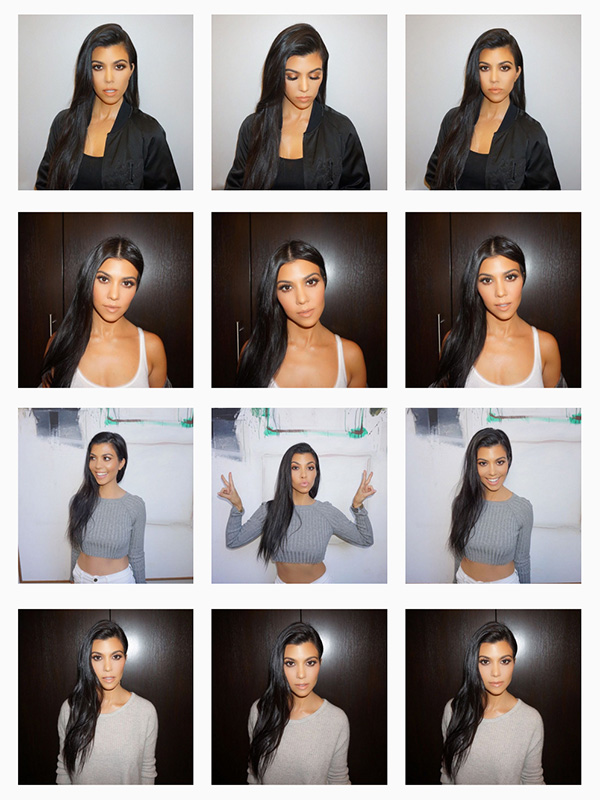
Kourtney Kardashian has mastered the art of the #triplegram—a series of three related photos posted to Instagram consecutively (something that any pre-Instagram photographer would identify as a triptych).

As People magazine explains: “Sometimes the tiled photos will culminate in one overall image or sometimes it’s just a three-peat that fills out the row. It would seem that Kourtney is all about the three-peat.”


Image via People

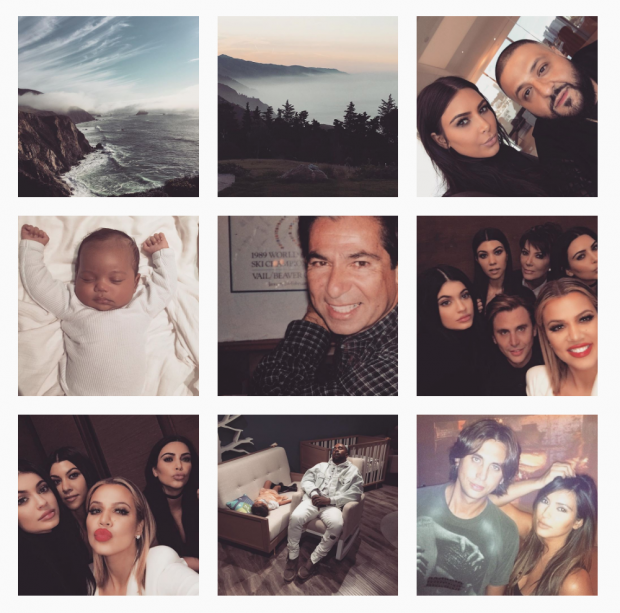
On the other hand, her sister Kim Kardashian is all about creating consistency through the look and feel of her feed overall. Kim’s photos typically have a matte-finish look with muted tones reminiscent of film photography. Wherever you land in her feed, it’s clear whose photos you’re looking at.

Image via Kim Kardashian’s Instagram Feed

I never thought I’d say this, but brands can learn a lot from the Kardashians.

9. They talk up their friends

Who do you see most often in celebrity photos (other than the celeb you’re following)? Their friends and family of course, just like anyone else.

Except for them, those people just happen to be other celebs.

Like anyone, they’re proud of their friends and their accomplishments. And they aren’t afraid to talk them up.

They’re all about the casual name-drop mention.

You might be thinking: my brand doesn’t hang out with celebrities, how is this useful to me?

The key, you see, is in the mentions. Brands should mention their friends, influencers, and customers in posts. Tag people to show a little love and increase the potential reach of your content. After all, if you mention them, maybe they’ll mention (or even Regram) you!

10. They get that it’s all about the fans

Celebrities are only famous because of their fans. But some of them are better than others at recognizing this crucial fact.

Taylor Swift is the undisputed queen of this.

She’s always doing something to recognize her fans. Take her wildly popular Swiftmas, where she social-stalked some fans and sent them their dream gifts for Christmas (and posted a video of herself wrapping them, of course). Or her propensity for commenting on fans’ Instagram photos with funny quips and moving advice. Or just look at how she shows off her appreciation for her fans on her own feed.

One of the best ways for brands to show appreciation for their fans on Instagram is, of course, engagement. Like and comment on photos that have to do with your brand or your business. Emulate Taylor Swift and make your interactions personable. And never underestimate the power of the Regram.

Whether you follow celebs on Instagram or not, there’s a lot that brands can learn from them.

Wednesday, January 25, 2017

Social Media Sites That Matter to Marketers

Image result for Top Social Media Sites That Matter to Marketers

While preparing for a recent dinner party, I visited my local overly-priced grocer with the intention of purchasing a few items for a cheese board. Getting cheese from “the nice part of the store” was novel enough for this gal, until I got there and realized the overwhelming amount of dairy at my disposal. I started haphazardly picking up chunks of cranberry goat cheese and funky looking blue cheese, throwing anything I saw into my basket.
Many social media marketers approach signing up for social networks the same way. With my dinner party, I felt as if I had to please everybody and therefore have the most varieties of cheese possible, when eventually my successful cheese plate consisted of the most popular, crowd-pleasing classics (shout-out to brie). You may feel like if you don’t have a presence on each and every network you’re missing out on audience members there, but the time and money required for keeping up with this mass platform strategy is unrealistic and exhausting for any social media marketer.

Best social media sites and platforms

While it may seem like there’s a hot new social media network being launched every day, the truth is that there are currently a core group of platforms that are key to consider for your social media strategy. To help you narrow down your options, we’ve outlined key demographics of the top social media sites and platforms that matter to social media marketers.

YouTube

Demographics and stats

General
  • Monthly Users: 215,690,880 (as of March 2016)
  • YouTube has over 1 billion users (almost one-third of all people on the internet)
  • YouTube usage is up 40 percent since March 2014
Age
Gender
  • Female-identified users: 46 percent of total users
  • Male-identified users: 54 percent of total users
Income
Education

Why YouTube is a top social media site

With video a key component of content marketing in 2016, the number of brands using the channel is steadily on the rise. If you’re wondering why YouTube is a good option for your marketing efforts, our post, “How to Fuel Your YouTube Video Marketing,” explains that YouTube works through “taking a very core marketing concept—solving problems your target customer is facing—but presenting it in a way that is unique to your brand and channel.”
Besides being the second largest online search engine, YouTube is also heavily used as a resource for how-to content. YouTube explains this best:“As YouTube “Millennials and today’s independent buyer turn to YouTube to get quick answers, and you can easily become their go-to expert with incredible ‘how-to’ video content.” The key here is to think about the type of questions your customers and audience members are asking, or could be asking in the future, and provide unique, personality-filled answers to these questions and problems.”
Some brands who are cleverly using YouTube as a core component of their strategies include:

Facebook

Demographics and stats

General
  • Monthly Active Users: 1.79 billion (as of September 30, 2016)
  • More than 1 billion people use Facebook daily
  • 71 percent of American adults with access to the internet use Facebook
  • 83.6 percent of Facebook’s daily active users are outside the U.S. and Canada
Age
  • 82 percent of online adults ages 18 to 29 use Facebook
  • 56 percent of online users ages 65 and up use Facebook
  • 79 percent of those ages 30 to 49 use Facebook
Gender
  • Female-identified users: 76 percent of all female-identified U.S internet users use Facebook
  • Male-identified users: 66 percent of all male-identified U.S internet users use Facebook
Income
  • 72 percent of Facebook users have incomes of over $75,000
Education
  • 74 percent of Facebook users have some form of higher education

Why Facebook is a top social media site

Since its birth in 2004, Facebook has been a staple in social media marketing plans around the world. There are countless reasons for this, but as our post “Our Best Facebook Posts, and What We Learned From Them” explains, “Facebook is probably a more powerful business tool than it has ever been. The company is pushing e-commerce features like a brand new buy button; it ramped up its video strategy, making it a serious competitor for YouTube; and Facebook ads are becoming more accessible to all businesses.”
While countless reasons for using Facebook in your marketing strategies, the company cites these key areas it can help with:
  • Driving online sales
  • Increasing local sales
  • Increasing brand awareness
  • Promoting your app
  • Finding leads
  • Social customer service
Some brands who have found incredible success, and act as solid examples of what Facebook can do for your business, include:
  • The New York Times—who saw a 2.3 times increase in volume of subscription conversions
  • The Skimm—who saw a 22 percent increase in lead quality, with a $1 to $2 cost per acquisition
  • Absolut—who saw a four point lift in favorability via Facebook
  • Eggo—who saw a 4.2 times return on ad spending and 3.2 percent in household reach

Twitter

Demographics and stats

General
  • Monthly Users : 80,173,808 (as of March 2016)
  • 23 percent of all internet users and 20 percent of the entire U.S adult population use Twitter
  • 50 percent of users visit or shop at the website of an small or medium business they follow
  • 60 percent of users bought something because of something they saw on Twitter
Age
Gender
  • Female-identified users: 15 percent of all female-identified U.S. internet users use Twitter
  • Male-identified users: 22 percent of all male-identified U.S. internet users use Twitter
Income
  • 54 percent of Twitter users have incomes of over $50,000
Education
  • 30 percent of users have some form of higher education

Why Twitter is a top social media site

As most brands know, 140 characters can be a powerful thing. While there were rumors in 2015 and 2016 that Twitter was increasing its signature character limit, CEO Jack Dorsey touched on one key benefit of Twitter when he dismissed these claims, stating: “It’s staying. It’s a good constraint for us. It allows for of-the-moment brevity.”
It’s this brevity that forces brands to get their messages out in the clearest, most concise manner possible. Besides this, there are countless reasons why businesses such as yours love Twitter, including:
While there are tons of brands on Twitter, some of the best examples of using the network for your business needs are the following:

Pinterest

Demographics and stats

General
Age
Gender
  • Female-identified users: 42 percent of all female-identified U.S. internet users use Pinterest
  • Male-identified users: 13 percent of all male-identified U.S. internet users use Pinterest (the most rapidly growing demographic for the site)
Income
  • 34 percent of Pinterest users have incomes of over $75,000
  • 64 percent of Pinterest users have incomes of over $50,000
Education
  • 32 percent of users have some form of higher education

Why Pinterest is a top social media site

The business value of Pinterest is undeniable. In addition to the statistics outlined above, our recent post, “Using Pinterest for Business,” highlights the fact that Pinterest can be a huge driver of traffic for professional sites. Numerous bloggers we spoke to declared Pinterest to be the biggest driver of traffic to their sites, information that emphasizes the network’s position as a serious component for any social media strategy.
Whether using Pinterest to Pin your products, uses and demos for your products, or lifestyle and industry-relevant content, the platform is one that your brand should seriously consider including in your plan. The following brands saw the power of Pinterest, and experienced great success using it for their business:
  • Homepolish—who saw at least 10 percent of their site traffic come from Pinterest, with 75 percent of those unique visitors new to the brand
  • Topshop—who saw a 260 percent increase in impressions thanks to Pinterest
  • Hearst—who saw a 715 percent increase year over year in traffic to their sites thanks to Pinterest

Instagram

Demographics and stats

General
Age
Gender
  • Female-identified users: 49 percent of Instagram users identify as female
  • Male-identified users: 51 percent of Instagram users identify as male
Income
  • 26 percent of Instagram users have incomes of over $75,000
  • 52 percent of Instagram users have incomes of over $50,000
Education
  • 24 percent of users have some form of higher education

Why Instagram is a top social media site

It’s no secret that visuals add a certain dimension to your content that words alone sometimes can’t quite grasp (a painful sentence for this writer to put down). In just five short years, Instagram has skyrocketed by being a place for marketers to easily and effectively showcase their brand through images, short videos clips, and the overall cohesion of visual content.
As not only a platform with extremely attractive demographics, as outlined above, Instagram highlights the following three key reasons content succeeds on the platform.
  • Passionate Community—with Instagram’s 400 million users globally, those on the platform are engaged and active.
  • Creative Context—users go to Instagram to view beautiful or interesting images, so placing your business’ content here means you are presenting to a creative, image-driven audience.
  • Visual language—with the focus on images, Instagram offers an easy-to-digest and aesthetically pleasing arena for your brand’s visual content to take center stage.
Brands and businesses quickly caught on to Instagram’s marketing potential, and have seen huge success with the platform. Some of the best success stories are the following:
  • Mercedes Benz—who saw a 27 point lift in ad recall thanks to their Instagram campaign
  • Coca-Cola—who saw a seven-point lift in message association between Coca-Cola, happiness, and friendship
  • Fido—who saw 2 million people reached in eight weeks, a 19 point lift in ad recall amongst Millennials, and a four point lift in brand recommendation

LinkedIn

Demographics and stats

General
Age
Gender
  • Female-identified users: 44 percent of LinkedIn users identify as female
  • Male-identified users: 56 percent of LinkedIn users identify as male
Income
  • 44 percent of LinkedIn users have incomes of over $75,000
  • 75 percent of LinkedIn users have incomes of over $50,000
Education
  • 50 percent of users have some form of higher education

Why LinkedIn is a top social media site

While many think of LinkedIn as solely a professional networking site, it has become much more for many brands. As a knowledge and information-sharing hub, LinkedIn allows like-minded people to find each other, form communities, and, yes, network professionally. For brands, this means that it has the potential to create thought-leaders out of their CEOs, share updates from their businesses to an interested audience, and provide valuable and relevant information on a regular basis.
LinkedIn shares that the most successful brands on the site do the following three things:
  • They continually update users on industry news.
  • They release new and engaging content tailored to specific audiences.
  • They add their voice to relevant conversations that their audiences care about.
Some great examples of brands who successfully use LinkedIn for business purposes include:
  • KLM—who created a 24/7 customer service group on LinkedIn in order to respond to customers’ inquiries
  • EY—who used LinkedIn to position themselves as key thought leaders in the accounting industry
  • HubSpot—who drive high-quality leads in the LinkedIn feed with Sponsored Updates

Snapchat

Demographics and stats

General
Age
Gender
  • Female-identified users: 70 percent of Snapchat users identify as female
  • Male-identified users: 30 percent of Snapchat users identify as male
Income
  • 62 percent of Snapchat users have incomes of over $50,000
  • 38 percent of Snapchat users have incomes of under $50,000
Education
  • 70 percent of post-secondary students use Snapchat

Why Snapchat is a top social media network

While not technically a social media site, Snapchat is a social platform you and your company should definitely care about. When advertising and content marketers first heard of a platform where the content would live for 24 hours, tops, I’m sure there were scoffs heard around open offices and pour-over coffee stations everywhere. However, since its inception in 2011, Snapchat has skyrocketed in prominence, becoming the place to be for many social media marketers. As an extremely popular platform for those under the age of 34, Snapchat is an incredibly valuable network for those trying to target this highly desirable demographic. Including the appealing demographics, there are three key reasons businesses on Snapchat love the app:
  • The Best Mobile Video Platform—with a focus on vertical rather than horizontal video
  • Snapchatters—the “passionate and engaged” audience demographic
  • Curated Content—as explained by AdAge, “[Snapchat] offers something unique in the world of mostly-broadcast, feed-centric social media—intimacy at scale.”
However, if you want to get inside the heads of your targeted demographic, Snapchat found that 13 to 34 year olds love the app because it allows them to:
  • Get perspective—”Snaps provide a personal window into the way you and your friends see the world.”
  • Be here, now—”Stories are updated in real-time and expire after 24 hours.”
  • Express yourself—”Snaps are a reflection of who you are in the moment—there is no need to curate an everlasting persona.”
If your brand or business is looking to begin using Snapchat, or are having trouble connecting with an audience there, think about these reasons that the core Snapchat demographic are using it. Snapchat users love the personal aspect of the app, so perhaps your brand can offer behind the scenes footage or clips of your CEO offering quick video snippets of advice. The audience also loves the real-time nature and maximum 24 hour lifespan of a Snap Story, making it a great place to share brief, exciting company or industry updates. For more ideas on how to use Snapchat for your business, our post, “Smart ways to use Snapchat for business,” provides a thorough guide. Additionally, looking at some examples from other businesses can prove helpful. To offer inspiration, here are some brands that are doing Snapchat right.
  • CNN—quoted in Snapchat’s advertising info page, CNN is communicating through Snapchat in a less formal way than on their other media channels, and in doing so, reaching a completely new audience.
  • Mashable—Mashable uses Snapchat to share industry news, provide behind the scenes access to their offices and employees, and provide Snapchat videos of live events (such as new Apple product launches).
  • Refinery29—who consistently provide short, easily digestible content featuring beauty, fashion, and lifestyle advice.
With these top social media sites in mind, you can see why—just like I didn’t need every single type of cheese to have happy dinner party guests—you don’t need to be on each and every social media platform to reach your social media goals. Instead, concentrate on building and maintaining a high-quality presence with a core set of social media platforms.