Showing posts with label Cameos from Cape Town. Show all posts

Wednesday, August 2, 2017

Writing Tools for Crafting the Perfect Social Media Post


Ernest Hemingway once said, “There is nothing to writing. All you do is sit down at a typewriter and bleed.”
Okay. As a social media marketer, there’s a good chance you aren’t penning from a typewriter. We also hope that wherever you do pen from, it’s blood free.
Even so, you get the point. Writing is hard.
Writing is also a skill that social marketers need to have. Social media posts, after all, have a pesky habit of not writing themselves.
The good news? There is now a whole army of online writing tools out there to make your life easier. We’ve compiled eight of our favorites below.

1. Hemingway App

Good for: Strengthening prose by eliminating unnecessary language.
Cost: $19.99 for desktop; free online
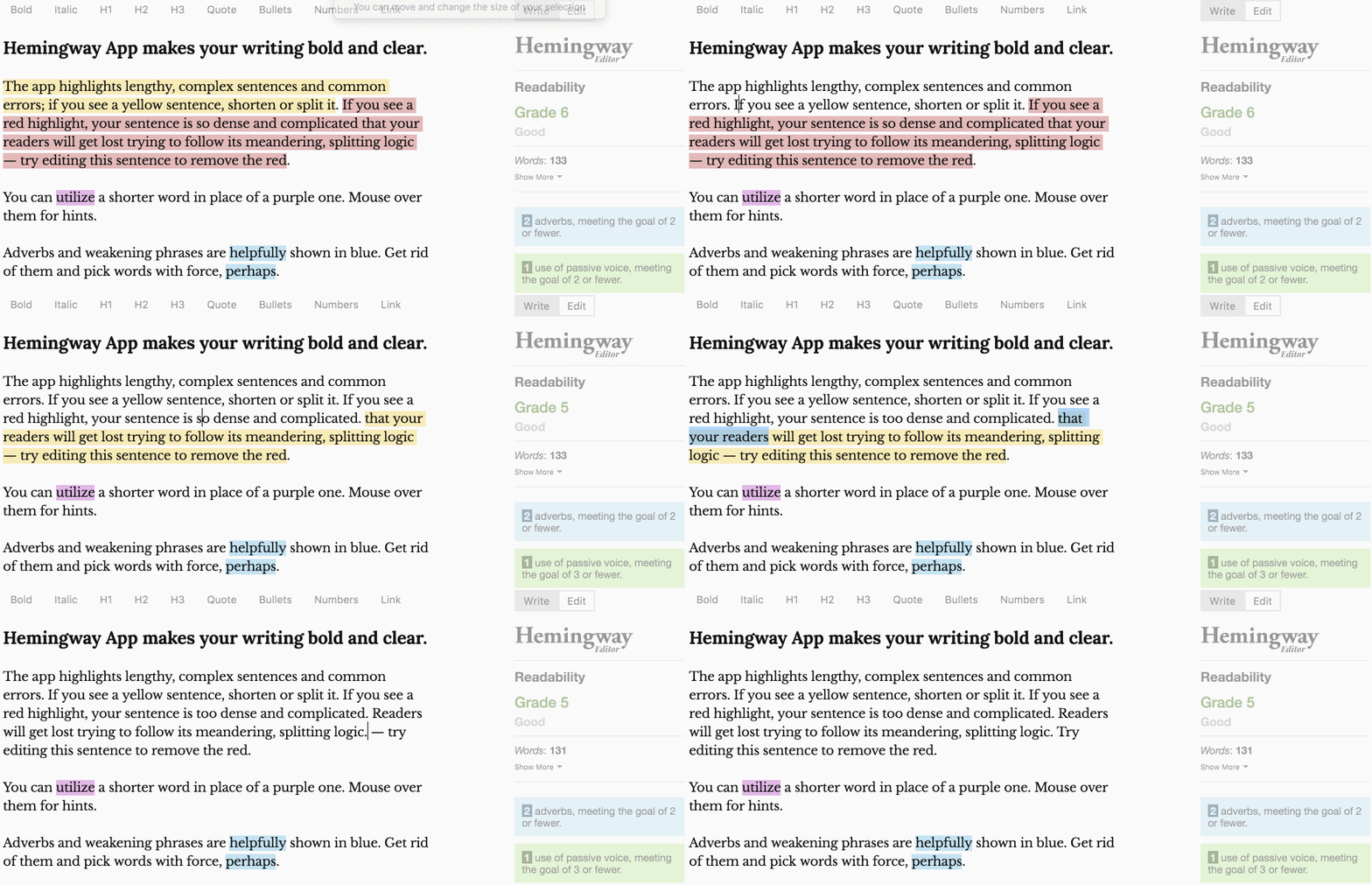
The Hemingway Editor strengthens your writing by highlighting sentences that will likely lose your readers. The tool also highlights complex words, adverbs, and instances of passive voice and give hints for alternatives.
To use it, simply paste your text into the online editor. It’ll review your writing and generate recommendations for improvement.

2. Writefull

Good for: Comparing words and phrases to see which option is more common (and likely accurate)
Cost: Free
writing tools for social media
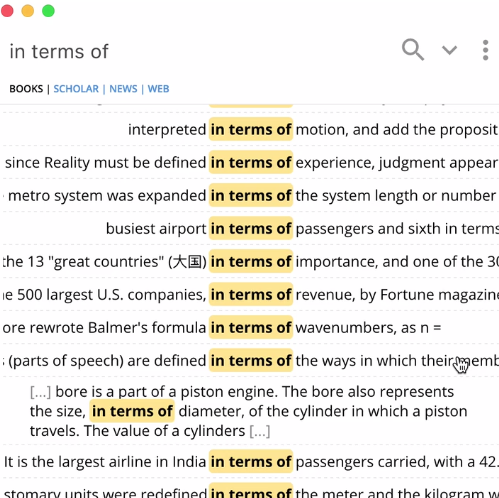
The Writefull extension draws from large language databases (like Google Books and Google Web) to search for the frequency of phrases of text. Writefull can be activated in any writing tools (like Word or Outlook) and is super easy to use.
After downloading the plug-in, highlight the chunk of text you want to check (from whatever writing tool you’re using) and activate the Writefull pop-up by clicking CTRL + SPACE and pick the database you want to pull your results from.
Writefull is handy for:
  • Checking how often a portion of text appears in a database—the higher the number the better the odds are that it’s written correctly.
  • Comparing two chunks of writing to see which is more common in the database.
  • Seeing words in context—quickly see the most appropriate adjectives or prepositions to use in a phrase of text.
  • Getting synonyms in context—helpful if you find yourself using the same words repeatedly.

3. Captiona

Good for: Generating caption ideas for Instagram and Snapchat
Cost: $0.99 per download from the App Store.
Coming up with clever Snapchat and Instagram captions can be tough, especially when you’re posting a lot of photos and generally pressed for time. Enter Captiona, an app that generates captions for Instagram and Snapchat posts.
Optimized for iPhones and iPads, The app is essentially a search engine for social media captions that produces ideas based on keywords associated with your photo or video content.
After entering in those keywords, Captiona comes up with a bank of captions that you can pick and choose from. While some are quite generic, many are surprisingly clever.

4. ZenPen

Good for: Distraction-free writing.
Cost: Free
writing tools for social media
Staying focused on writing while at work can be a challenge. Especially with all the team chat pings and chatting colleagues buzzing around to distract you at any moment.
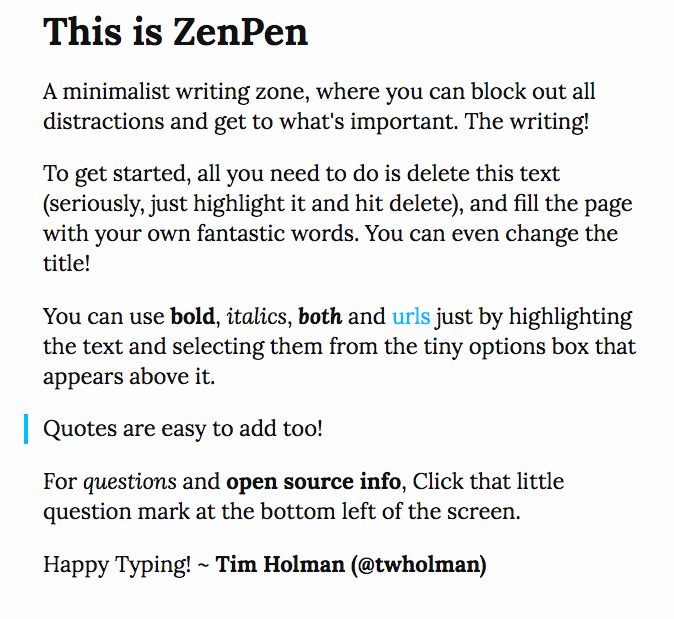
ZenPen helps you block out all those distractions with a minimalist writing zone. The full-screen enabled site offers a handy word count feature and drafts can even be downloaded for safe-keeping.

5. Power Thesaurus

Good for: Sourcing alternative words to add more variety to your writing
Cost: Free online
writing tools for social media
Stuck for a new way to say the same thing? Power Thesaurus could be your best word-hunting friend yet.
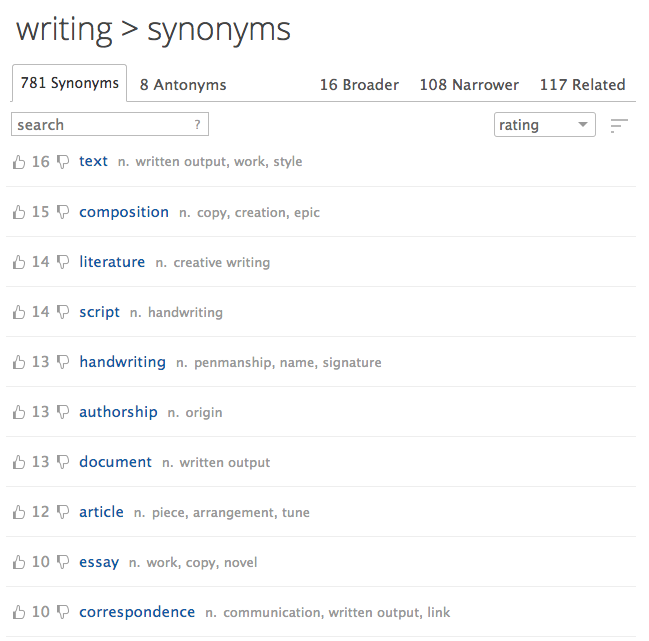
Not your average thesaurus, Power Thesaurus is a crowdfunded tool that generates synonyms from a large community of writers. All suggestions are based on the actual work of the community and are rated and ranked by members.

6. Grammarly

Good for: Granular grammar and spelling review
Cost: Free online
Writing tools for social media
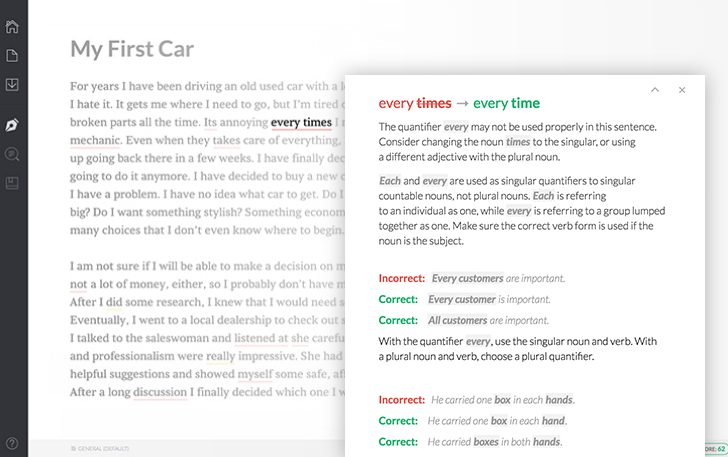
Grammatical and spelling errors happen, especially when you’re rushed to get your social posts published. These sorts of errors can be pretty funny when published from personal accounts. For brands, however, errors in social media posts can negatively impact your reputation.
Grammarly promises to keep your social posts on point, flagging everything from contextual spelling errors to poor word choices. And the tool integrates with lots of online platforms including Twitter, Gmail, and Tumblr.

7. Correctica

Good for: Spelling and grammar check
Cost: $29.95/year for unlimited scans (first 10 scans are free)
Correctica is another helpful grammar check tool. While Correctica’s primary function is to scan website content for errors, they also offer personalized content reviews.
To take advantage of the service you need to email your documents to Correctica and they promise the return of proofed copy within minutes.

8. ProWritingAid

Good for: In-depth evaluation of your writing
Cost: Free online; premium desktop contracts ranges from $40 to $140
Writing tools for social media
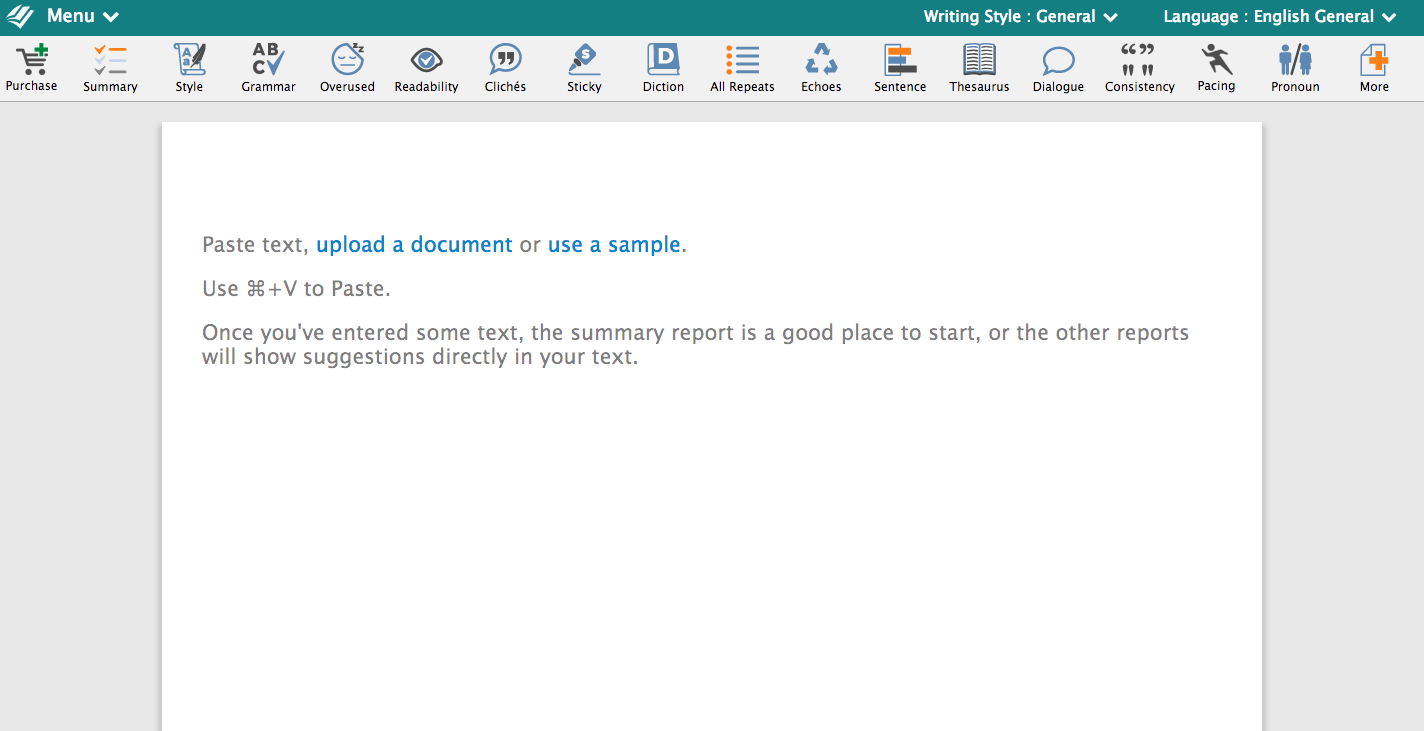
Like the Hemmingway App, ProWritingAid is another handy writing evaluation tool. Available in desktop and a free online version, the tool flags redundancies, lengthy sentences, and clichés. It also checks for plagiarism.
While the free version is very functional, it is limited to 3,000 words per review. Something to keep in mind if your content team plans to use the tool for more than reviewing short social media posts.

Tuesday, October 11, 2016

10 Books Every Social Media Manager Should Read


10 Books Every Social Media Manager Should Read

When I was young, my summer holiday usually kicked off with a visit to the local library to sign up for the summer reading program. Kids around the city would eagerly devour book after book, in the hopes of the ultimate prize—a new book of their choice. As an adult, the fact that I can go and just get a book whenever I please ranks right up there with the disbelief that I can also get candy whenever I want.

I’m not going to sit here and pretend that I only read marketing books. I’m not a dirty liar. But there are a select few resources that every social media manager needs to read.
While I could provide a list of the top 10 marketing books as recommended by Amazon, there is much more that goes into being a successful social media manager than simply “social media managing.” Don’t get me wrong, these books are there for a reason (and you’ll find some of them below), but a great social media manager needs a wide variety of skills.

Content Strategy for the Web

By Kristina Halvorson and Melissa Rach
This book has been making its way around the Hootsuite offices, becoming more disheveled with each handoff. Many colleagues have been tooting the horn of authors Kristina Halvorson and Melissa Rach approach to content strategy.
Social media is a crucial part of content marketing, so mastering the art of content strategy is something you need to know how to do. Halvorson and Rach teach you exactly how to do this, sharing their expertise and instructions on everything from completing a content audit to leading a project. If others in your company don’t think that content strategy is important, fear not—the authors shares the perfect persuasion tactics for this situation.

Purple Cow

By Seth Godin
Described as “the godfather of marketing books” by another Hootsuite employee, Purple Cow has more than just an intriguing title. Author Seth Godin aims to change the way people think about marketing.
It can be difficult for social media managers to come up with original content day in and day out, so sometimes you just need a purple cow. As Godin explains, “Purple Cow describes something phenomenal, something counterintuitive and exciting and flat out unbelievable. Every day, consumers come face to face with a lot of boring stuff—a lot of brown cows—but you can bet they won’t forget a Purple Cow.”
Delight your audience and customers after you get inspired to create your own “purple cows” with your social media content.

Contagious: Why Things Catch On

By Jonah Berger
A New York Times bestseller and named the Best Marketing Book of 2014 by the American Marketing Association, many members of the Hootsuite marketing department recommend this book. While ‘going viral’ might not be the best goal for a social media manager, getting your brand noticed on social is definitely a key objective.
Berger dives into six “contagious” qualities that impact everything from consumer products to media content. Learn how you can use these qualities to create your own shareable content.

Thinking, Fast and Slow

By Daniel Kahneman
Why do we do what we do? What drives the choices that we make? These are important things for any social media manager to think about when crafting content, and Daniel Kahneman’s work explores these ideas in-depth. A Nobel Prize winner for his work on decision-making, Kahneman is an expert in human behavior—something that any social media manager needs to understand.

Connected: The Surprising Power of Our Social Networks and How They Shape Our Lives — How Your Friends’ Friends’ Friends Affect Everything You Feel, Think, and Do

By Nicholas A. Christakis and James H. Fowler
Authors and scientists Nicholas Christakis and James Fowler explore the social networks and connections human beings have, and how these connections influence our decisions.
As a social media manager, you know that your online networks have huge power, so learning how these connections work, and how to grow them, will help inform your social strategy.

Everybody Writes

By Ann Handley
I included this irreplaceable resource in my post So You Think You Can’t Write: 8 Writing Resources for Non-Writers and it’s a definite must-read for social media managers.
Writing is a skill that all marketers need to have, and Ann Handley offers a clear and concise guide to mastering it. Handley explains that content is “everything your customer or prospect touches or interacts with—including your own online properties and web pages and the experiences they offer, but also everything on any social channel.”
If you are trying to get your audience’s attention, you’re going to need the social media content to match. This book will help you create just that.

Hug Your Haters

By Jay Baer
Social media customer service is undoubtedly an area every social media manager needs to master, and Jay Baer’s book is the perfect resource. You already know that ignoring your upset customers on social media is a poor approach, but knowing exactly how to deal with them can be a challenge. With this book, you’ll learn how to not only manage your “haters,” but turn every negative experience into a positive one that can work for you and your brand.

Likeable Social Media

By Dave Kerpen
I was crossing the border into the United States for a shopping trip recently, and the border security officer asked what I do for work. I explained that I write. When I told him “social media and content marketing” he let out a loud groan. What is it about the subject that makes some people cringe? How do you ensure that you aren’t sharing cringe-worthy content on your own channels?
Author Dave Kerpen explores how to listen to your customers so that you can deliver valuable content—and prove even the most cynical border security guards wrong.

Social IMC: Social Strategies with Bottom-Line ROI

By Randy Hlavac
Having a social media plan is all well and dandy, but do you know how your strategy actually benefits your business? Author Randy Hlavac explains “there are many books out there on the theories behind the use of social media and mobile applications in marketing—but this is not one of them.”
Instead of broad theories, Hlavac provides actionable strategies and proven tactics that can bring results. This social media how-to guide will show you how to build a strategy , with you at the helm, your brand sees profit and growth

Jab, Jab, Jab, Right Hook: How to Tell Your Story in a Noisy Social World

By Gary Vaynerchuk
As a social media manager, you know that one of your biggest challenges is getting your message heard. The sheer volume of content shared every second means that you need to work extremely hard to make sure you’re creating unique and valuable content. This is where Gary Vaynerchuk’s book comes in. He shows you how to adapt your content to specific channels and how to keep up with the ever-changing nature of the social media landscape.
In order to be successful in the world of social media and content marketing, you need to stay ahead of the curve. While theory can easily become outdated, the above references are great for building a solid foundation of ideas and skills.

Monday, October 10, 2016

Professor Oliver Hart continues a Jewish Tradition..... Wins the 2016 Nobel Prize for Economics

Oliver Hart
BornOliver Simon D'Arcy Hart
1948
LondonUK
ResidenceUnited States
CitizenshipUnited States
NationalityBritish
FieldsLaw and Economics
InstitutionsHarvard University
Massachusetts Institute of Technology
London School of Economics
Alma materKing's College, Cambridge B.A.
University of Warwick M.A.
Princeton University Ph.D.
Notable awardsNobel Memorial Prize in Economic Sciences (2016)
Image result for Olive Hart Nobel Prize
Oliver Simon D'Arcy Hart (born 1948) is a British economist and the Andrew E. Furer Professor of Economics at Harvard University. Together with Bengt R. Holmström, he received the Nobel Memorial Prize in Economic Sciences in 2016.


Biography

Oliver Hart was born in Britain to Philip D'Arcy Hart, a famous seminal medical researcher fromGreat Britain and Ruth Mayer, gynecologist. Both his parents were Jewish, while his father was a member of prominent noble Jewish family Montagu—Oliver's grand-grandfather was Samuel Montagu, 1st Baron Swaythling.
Hart is an American citizen and Jewish. He is married to writer Rita B. Goldberg, a Harvard literature professor and author of the second-generation Holocaust memoir “Motherland: Growing Up With the Holocaust.” They have two sons and two grandsons.
Hart earned his B.A. in mathematics at King's College, Cambridge in 1969 (where his contemporaries included the former Bank of EnglandGovernor Mervyn King), his M.A. in economics at University of Warwick in 1972, and his Ph.D. in economics at Princeton University in 1974. He then became a fellow at Churchill College, Cambridge and a professor at the London School of Economics. In 1984, he returned to the U.S., where he taught at the Massachusetts Institute of Technology and, since 1993, at Harvard University. He was chairman of the Harvard economics department from 2000 to 2003. He is a fellow of the American Academy of Arts and Sciences, of the Econometric Society, of the American Finance Association, a corresponding fellow of the British Academy, and a member of the National Academy of Sciences. He has been president of the American Law and Economics Association and vice president of the American Economic Association, and has severa lhonorary degrees.
Oliver won the Nobel Prize in Economics in 2016 for his work on contract theory.

Academics

He is an expert on contract theorytheory of the firmcorporate finance, and law and economics. His research centers on the roles thatownership structure and contractual arrangements play in the governance and boundaries of corporations. He has used his theoretical work on firms in two legal cases as a government expert (Black and Decker v. U.S.A. and WFC Holdings Corp. (Wells Fargo) v. U.S.A.).

Books

  • Firms, Contracts, and Financial Structure (Oxford University Press, 1995).

Selected articles[edit source]

  • "On the Optimality of Equilibrium when the Market Structure is Incomplete", Journal of Economic Theory, December 1975, 418-443
  • "Takeover Bids, the Free-rider problem, and the Theory of the Corporation" (with Sanford J. Grossman), Bell Journal of Economics, Spring 1980, 42-64
  • "An Analysis of the Principal–Agent Problem" (with Sanford J. Grossman), Econometrica (January 1983) 7-46.
  • "The Market Mechanism as an Incentive Scheme," Bell Journal of Economics, 14 (Autumn 1983) 366-82.
  • "The Costs and Benefits of Ownership: A Theory of Vertical and Lateral Integration" (with Sanford J. Grossman), Journal of Political Economy, August 1986, 691-719.
  • "One Share-One vote and the Market for Corporate Control" (with Sanford J. Grossman), Journal of Financial Economics, 1988
  • "Incomplete Contracts and Renegotiation" (with John Hardman Moore), Econometrica 56(4) (July 1988).
  • "Property Rights and the Nature of the Firm" (with John Hardman Moore), Journal of Political Economy 98(6) (1990).
  • " A Theory of Debt Based on the Inalienability of Human Capital " (with John Hardman Moore), Quarterly Journal of Economics, November 1994, 841-879
  • "The Proper Scope of Government: Theory and an Application to Prisons" (with Andrei Shleifer and Robert W. Vishny), Quarterly Journal of Economics 112(4) (1997) 1126-61.
  • "Contracts as Reference Points" (with John Hardman Moore), Quarterly Journal of Economics, February, 2008,1-48.

Professor Oliver Hart continues a Jewish Tradition..... Wins the 2016 Nobel Prize for Economics

Image result for Olive Hart

Oliver Hart
BornOliver Simon D'Arcy Hart
1948
LondonUK
ResidenceUnited States
CitizenshipUnited States
NationalityBritish
FieldsLaw and Economics
InstitutionsHarvard University
Massachusetts Institute of Technology
London School of Economics
Alma materKing's College, Cambridge B.A.
University of Warwick M.A.
Princeton University Ph.D.
Notable awardsNobel Memorial Prize in Economic Sciences (2016)
Oliver Simon D'Arcy Hart (born 1948) is a British economist and the Andrew E. Furer Professor of Economics at Harvard University. Together with Bengt R. Holmström, he received the Nobel Memorial Prize in Economic Sciences in 2016.

Biography

Oliver Hart was born in Britain to Philip D'Arcy Hart, a famous seminal medical researcher fromGreat Britain and Ruth Mayer, gynecologist. Both his parents were Jewish, while his father was a member of prominent noble Jewish family Montagu—Oliver's grand-grandfather was Samuel Montagu, 1st Baron Swaythling.
Hart is an American citizen and Jewish. He is married to writer Rita B. Goldberg, a Harvard literature professor and author of the second-generation Holocaust memoir “Motherland: Growing Up With the Holocaust.” They have two sons and two grandsons.
Hart earned his B.A. in mathematics at King's College, Cambridge in 1969 (where his contemporaries included the former Bank of EnglandGovernor Mervyn King), his M.A. in economics at University of Warwick in 1972, and his Ph.D. in economics at Princeton University in 1974. He then became a fellow at Churchill College, Cambridge and a professor at the London School of Economics. In 1984, he returned to the U.S., where he taught at the Massachusetts Institute of Technology and, since 1993, at Harvard University. He was chairman of the Harvard economics department from 2000 to 2003. He is a fellow of the American Academy of Arts and Sciences, of the Econometric Society, of the American Finance Association, a corresponding fellow of the British Academy, and a member of the National Academy of Sciences. He has been president of the American Law and Economics Association and vice president of the American Economic Association, and has severa lhonorary degrees.
Oliver won the Nobel Prize in Economics in 2016 for his work on contract theory.

Academics

He is an expert on contract theorytheory of the firmcorporate finance, and law and economics. His research centers on the roles thatownership structure and contractual arrangements play in the governance and boundaries of corporations. He has used his theoretical work on firms in two legal cases as a government expert (Black and Decker v. U.S.A. and WFC Holdings Corp. (Wells Fargo) v. U.S.A.).

Books

  • Firms, Contracts, and Financial Structure (Oxford University Press, 1995).

Selected articles[edit source]

  • "On the Optimality of Equilibrium when the Market Structure is Incomplete", Journal of Economic Theory, December 1975, 418-443
  • "Takeover Bids, the Free-rider problem, and the Theory of the Corporation" (with Sanford J. Grossman), Bell Journal of Economics, Spring 1980, 42-64
  • "An Analysis of the Principal–Agent Problem" (with Sanford J. Grossman), Econometrica (January 1983) 7-46.
  • "The Market Mechanism as an Incentive Scheme," Bell Journal of Economics, 14 (Autumn 1983) 366-82.
  • "The Costs and Benefits of Ownership: A Theory of Vertical and Lateral Integration" (with Sanford J. Grossman), Journal of Political Economy, August 1986, 691-719.
  • "One Share-One vote and the Market for Corporate Control" (with Sanford J. Grossman), Journal of Financial Economics, 1988
  • "Incomplete Contracts and Renegotiation" (with John Hardman Moore), Econometrica 56(4) (July 1988).
  • "Property Rights and the Nature of the Firm" (with John Hardman Moore), Journal of Political Economy 98(6) (1990).
  • " A Theory of Debt Based on the Inalienability of Human Capital " (with John Hardman Moore), Quarterly Journal of Economics, November 1994, 841-879
  • "The Proper Scope of Government: Theory and an Application to Prisons" (with Andrei Shleifer and Robert W. Vishny), Quarterly Journal of Economics 112(4) (1997) 1126-61.
  • "Contracts as Reference Points" (with John Hardman Moore), Quarterly Journal of Economics, February, 2008,1-48.