Showing posts with label Darori Fioundation. Show all posts

Tuesday, November 1, 2016

The Six Step Approach to creating a Social Media Marketing Plan

Image result for The Six Step Approach to creating a Social Media Marketing Plan


So you need to create a social media marketing plan. No easy task, right? Many of us struggle to iron out exactly what that is, let alone how to build one from scratch.
Put simply, every action you take on social networks should be a part of a larger social media marketing strategy. That means every post, reply, like, and comment should all be guided by a plan that’s driving toward business goals. It might sound complicated, but if you take the time to create a comprehensive social media strategy, the rest of your social efforts should follow naturally. Everyone can do this if they approach it correctly.
Learn what a social media marketing plan should include, and follow our six-step plan for creating your own.

What is a social media marketing plan?

A social media marketing plan is the summary of everything you plan to do and hope to achieve for your business using social networks. This plan should comprise an audit of where your accounts are today, goals for where you want them to be in the near future, and all the tools you want to use to get there.
In general, the more specific you can get with your plan, the more effective you’ll be in its implementation. Try to keep it concise. Don’t make your social media marketing strategy so lofty and broad that it’s unattainable. The plan will guide your actions, but it will also be a measure by which you determine whether you’re succeeding or failing. You don’t want to set yourself up for failure from the outset.

Step 1: Create social media objectives and goals

The first step to any social media marketing strategy is to establish the objectives and goals that you hope to achieve. Having these objectives also allows you to quickly react when social media campaigns are not meeting your expectations. Without goals, you have no means of gauging success or proving your social media return on investment (ROI).
These goals should be aligned with your broader marketing strategy, so that your social media efforts drive toward your business objectives. If your social media marketing strategy is shown to support business goals, you’re more likely to get executive buy-in and investment.
Go beyond vanity metrics such as Retweets and Likes. Focus on advanced metrics such as leads generated, web referrals, and conversion rate. For more on this, check out our post 7 Social Media Metrics that Really Matter—and How to Track Them.
You should also use the SMART framework when setting your goals. This means that each objective should be specific, measurable, attainable, relevant, and time-bound.
A Social media marketing plan should have S.M.A.R.T. goals
SMART goal example:
“For Instagram we will share photos that communicate our company culture. We will do this by posting three photos a week. The target for each is at least 30 likes and 5 comments.”
A simple way to start your social media marketing plan is by writing down at least three social media goals. Make sure to ask yourself what the goal will look like when completed, and use that to determine how you will track it.

Step 2: Conduct a social media audit

Prior to creating your social media marketing plan, you need to assess your current social media use and how it’s working. This means figuring out who is currently connecting with you via social, which social media sites your target market uses, and how your social media presence compares to your competitors’.
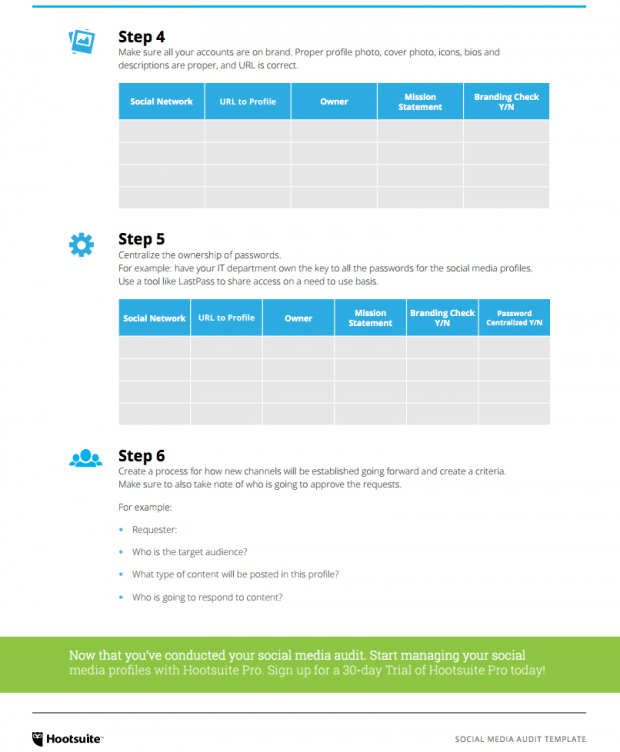
We’ve created a social media audit template that you can follow for each step of the process:
Social Media Audit Template 1
Social Media Audit Template 2
Once you’ve conducted your audit you should have a clear picture of every social account representing your business, who runs or controls them, and what purpose they serve. This inventory should be maintained regularly, especially as you scale your business.
It should also be evident which accounts need to be updated and which need to be deleted altogether. If your audit uncovers fraudulent accounts—a fake branded Twitter profile, for example—report them. Reporting fraudulent accounts will help ensure that people searching for you online only connect with the accounts you manage.
As part of your social media audit you’ll also want to create mission statements for each network. These one-sentence declarations will help you focus on a very specific goal for Instagram, Facebook, or any other social network. They will guide your actions and help steer you back on track if your efforts begin to lag.
Take the time you need to determine the purpose of every social profile you have. If you can’t figure out its purpose, you should probably delete that profile.
Mission statement example:
“We will use Snapchat to share the lighter side of our company and connect with younger prospect customers.”
Before you can determine which social media networks are right for your business, you first need to know who your audience is and what they want. We’ve created a guide to help you learn which social networks your audience lives on, which tools to use to gather demographic and behavioral data, and how to target the customers you want.
Bonus: Download a free guide that reveals how to increase social media engagement with better audience research, sharper customer targeting, and Hootsuite’s easy-to-use social media software.

Step 3: Create or improve your social accounts 

Once you’ve finished with your social media audit, it’s time to hone your online presence. Choose which networks best meet your social media goals. If you don’t already have social media profiles on each network you focus on, build them from the ground up with your broader goals and audience in mind. If you do have existing accounts, it’s time to update and refine them to get the best possible results.
We’ve created a guide on How to Set-up Facebook, Twitter, and Every Other Major Social Network to walk you through that process. Each social network has a unique audience and should be treated differently.
Optimizing profiles for SEO can help generate more web traffic to your online properties. Cross-promoting social accounts can extend the reach of content. In general, social media profiles should be filled out completely, and images and text should be optimized for the social network in question.
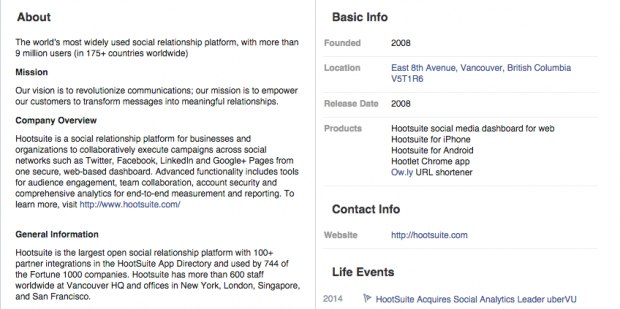
For your social media marketing plan make sure your social media profiles like your Facebook bio is complete

Step 4: Get social media inspiration from industry leaders, competitors, clients

Not sure what kinds of content and information will get you the most engagement? For inspiration, look to what others in your industry are sharing and use social media listening to see how you can distinguish yourself from competitors and appeal to prospects they might be missing.
Consumers can also offer social media inspiration, not only through the content that they share but in the way that they phrase their messages. See how your target audience writes Tweets, and strive to mimic that style. Also learn their habits—when they share and why—and use that as a basis for your social media marketing plan.
A final source of social media inspiration is industry leaders. There are giants who do an incredible job of social media marketing, from Red Bull and Taco Bell to KLM Airlines and Tangerine Bank. Companies in every industry imaginable have managed to distinguish themselves through advanced social media strategies. Follow them and learn everything you can. See if they’ve shared any social media advice or insight elsewhere on the web.
Here are a few suggested sources of inspiration in different areas of social media marketing:
  • Content marketing: Unbounce, Virgin
  • Social media customer service: Tangerine, Warby Parker
  • Social media advertising: AirBnB, the American Red Cross
  • Facebook strategy: Coca-Cola, Walmart
  • Google+ strategy: Cadbury, National Geographic
  • Twitter strategy: Charmin, Oreo
  • Instagram strategy: Herschel Supply Co., General Electric

Step 5: Create a content plan and editorial calendar

Having great content to share will be essential to succeeding at social media. Your social media marketing plan should include a content marketing plan, comprised of strategies for content creation and content curation, as well as an editorial calendar.
Your content marketing plan should answer the following questions:
  • What types of content you intend to post and promote on social media
  • How often you will post content
  • Target audience for each type of content
  • Who will create the content
  • How you will promote the content
Your editorial calendar lists the dates and times you intend to publish blogs, Instagram and Facebook posts, Tweets, and other content you plan to use during your social media campaigns.
Create the calendar and then schedule your messaging in advance rather than updating constantly throughout the day. This gives you the opportunity to work hard on the language and format of these messages rather than writing them on the fly whenever you have time. Be spontaneous with your engagement and customer service rather than your content.
 An example an editorial calendar for a social media marketing plan
An example editorial calendar
Make sure your calendar reflects the mission statement you’ve assigned to each social profile. If the purpose of your LinkedIn account is to generate leads, make sure you are sharing enough lead generation content. You can establish a content matrix that defines what share of your profile is allocated to different types of posts. For example:
  • 50 percent of content will drive back to your blog
  • 25 percent of content will be curated from other sources
  • 20 percent of content will support enterprise goals (selling, lead generation, etc.)
  • five percent of content will be about HR and culture
If you’re unsure of how to allocate your resources, a safe bet is to follow the Social Media Rule of Thirds:
  • One-third of your social content promotes your business, converts readers, and generates profit
  • One-third of your social content should share ideas and stories from thought leaders in your industry or like-minded businesses
  • One-third of your social content should be personal interactions with your audience

Step 6: Test, evaluate and adjust your social media marketing plan 

To find out what adjustments need to be made to your social media marketing strategy, you should constantly be testing. Build testing capabilities into every action you take on social networks. For example, you could:
  • Track the number of clicks your links get on a particular platform using URL shorteners and UTM codes
  • Use Hootsuite’s social media analytics to track the success and reach of social campaigns
  • Track page visits driven by social media with Google Analytics
Record and analyze your successes and failures, and then adjust your social media marketing plan in response.
Surveys are also a great way to gauge success—online and offline. Ask your social media followers, email list, and website visitors how you’re doing on social media. This direct approach is often very effective. Then ask your offline customers if social media had a role in their purchasing. This insight might prove invaluable when you look for areas to improve. Learn more about how to measure social media ROI for your business.
The most important thing to understand about your social media marketing plan is that it should be constantly changing. As new networks emerge, you may want to add them to your plan. As you attain goals, you will need to set new targets. Unexpected challenges will arise that you need to address. As you scale your business, you might need to add new roles or grow your social presence for different branches or regions.
Rewrite your social media strategy to reflect your latest insights, and make sure your team is aware of what has been updated.

Saturday, October 22, 2016

Marketing to Millennials: Content Should Reflect Their Values


Image result for Millennials Values

Millennials: everyone is talking about them and they seem to be the “Holy Grail” of the marketing world.
The millennial generation is often clumped into one, with assumptions that they are tech-savvy, self-absorbed, and overburdened with student debt. While this may be true for some of this group’s members, generalizing Gen Y negatively can cause businesses to miss out on this powerful demographic.
Millennials are a diverse group of individuals born between 1982 and 2000. Some remember a time before having the internet at home, and others can’t imagine life before Facebook.
Still, there are common characteristics that all millennials share that can be utilized to create an efficient marketing campaign. One such commonality is that millennials are overburdened with student debt. Close to 63 percent of millennials are expected to hold a Bachelor’s degree, and those don’t come cheap for the majority of students. The national student debt counter in the United States has long exceeded the $1 trillion mark, and is constantly growing.
Another similarity within Gen Y is their use of social media. According to 2014 numbers collected on millennial social media and internet use, 93 percent of millennials access the internet and use some form of a social media account. This means marketing to millennials should be easy, as social media campaigns that focus on data will provide companies with all the information they need to know about millennial customers; from what they buy to what they’re saying about brands or products.
This is huge news for marketers, and further underscores the importance of reaching the millennial generation. They may be struggling with debt, but evidence suggests that millennials still spend money with companies that they have grown to love.
Why? Because these companies have unique characteristics that make them stand out to the millennial market.
The key takeaway from these companies? Focus on the content of your message. Don’t just reach out to this group with emoji and memes. Instead, engage them where it matters most. Looking at the latest marketing trends, Rutgers University’s MBA program explained: “There has been a major influx amongst marketers to not only create content, but create content that is deemed both important and shareable… When users come across such content, they are far more likely to share it as it speaks to them on an emotional or intellectual level.”
Bonus: Download a free guide that reveals how to increase social media engagement with better audience research, sharper customer targeting, and Hootsuite’s easy-to-use social media software.
Here are some of the powerful ways marketers can reach millennials through their social media campaign.

3 keys to successful millennial marketing

Demonstrate that your brand cares about sustainability

Millennials are often assumed to be self-absorbed, but this is a huge misconception. Due to millennials’ consistent use of social media, they are frequently exposed to views and opinions that are not their own. This has led to what some researchers are deeming “a new form of empathy.” It goes to show that millennials care just as much about others across the world as they do about themselves.
A survey performed in 2014 by the Nielsen Global Survey Group found that millennials were the demographic most concerned about social responsibility. They explained: “[Millennials] represent 51 percent of [respondents across generations] who will pay extra for sustainable products and 51 percent of those who check the packaging for sustainable labeling.” Some have even argued that millennials are changing the way companies brand themselves.
So how does this translate to an online social media campaign? Follow the lead of some of the most successful companies that have focused on these key factors that concern millennials.
Patagonia is one group that has resonated with millennials through their “Don’t Buy This Jacket” campaign in 2011. Their message relied on the durability of their jackets and how infrequently customers should have to replace it. Their focus was on sustainable production and design, and—despite the message—sales for Patagonia improved 30 percent in 2012, and have continued to grow every year since.

Give back to the community

Companies that share their message of giving back to the community don’t just make the employees feel better about the company; they make the consumer feel better about their purchases too.
Businesses that build an online marketing strategy that shows how much they care for humans around the world can match the “new empathy” of millennials. One brand that has skyrocketed into success with this idea is Toms shoes.
Tom’s One for One Campaign was an instant hit when it was announced in 2006, and has since grown to encompass shoes, glasses, water, bully-prevention, and female reproductive health. Millennials and others were struck by the simple message and the ability to help others simply by purchasing stylish shoes for themselves.
Other companies such as Dove Soaps have seen a spike in sales due to millennial investment. When Dove released their “Real Beauty” campaign in 2014, it was an instant hit online. It proved to be a worthy cause as Dove saw a steady increase in sales over the next couple of years.
Businesses can learn from these examples and find ways to work similar messages into their own social media strategies. When creating content, find ways to include your company’s social responsibility campaign; from a new recycling program, to a new partnership with the Humane Society of America, or whatever you company’s chosen cause may be.
Also, if you don’t have a corporate social responsibility plan set-up, reach out to your followers on Twitter for ideas on where to get started. Be sure to get creative, and form partnerships with other companies that share your idea of what you want to do for your community.
Of course, millennials also love humor and lightheartedness, so be sure to keep your messages varied. You never want to overdo one over the other, but instead find a balance between sales, memes, and company messages.

Remember that honesty is the best policy

Millennials aren’t just swayed by green energy and activism. Gen Y also cares deeply about honesty and brand integrity. As many marketers and millennials have noted, this generation craves transparency and authenticity. They will only give attention to campaigns that are honest and engage with them, that show them what happens behind the scenes and not just flashy ads. This can be seen in company branding, thejob market, and even in politics.
Honest and truthful marketing campaigns are often the most powerful for reaching swaths of people, not just millennials. When companies take the opportunity to be honest about mistakes and provide transparency for their consumers, they often see benefits, particularly in their brand image.
Business writer Adeline Teoh explained the appeal of honest marketing: “People often joke that ‘truth in advertising’ is an oxymoron but truth does its own marketing for values such as honesty, integrity, and trustworthiness. Marketing isn’t just about persuading people that your business is ‘the best’—it’s about making your business memorable.”
In a world where information can be spread rapidly through social media, mistakes can be impossible to erase. Staying true to your company’s message and proving that you have the ability to learn from your mistakes will no doubt win you favor among Gen Y and improve your business.
Image result for Millennials Values

The key takeaways

There’s a lot to take away here, but some of the most essential points are:
  • Millennials may be in a lot of debt, but that doesn’t mean you should discount them in marketing campaigns.
  • Don’t pander with emoji and memes. Do your best to show Millennials how you are making a difference. Include humor as well as genuinely heartwarming and inspiring content.
  • Millennials have formed a new type of empathy. They’re not as self-absorbed as many people often think. They care about the environment and helping others.
  • Millennials are forcing the hand of many industries by choosing to purchase from brands that demonstrate social and environmental responsibility, even if it means a higher price point.
  • Honest and truthful marketing campaigns will not just win over millennials, but are better for your business in the long run.
Image result for Millennials Values

Sunday, October 16, 2016

Lessons Brands Can Learn from the Most Creative Accounts on Instagram


With 500 million active users, it can be hard to stand out from the crowd on Instagram. It just isn’t enough anymore to create your account, post beautiful pictures every now and then, and like a few photos. Brands, influencers, and the everyday Instagrammer are stepping outside the 1080px by 1080px square box and pushing the boundaries on creativity. If you really want your account to stand out from the brunch pics, selfies, and photos of feet, you need to think creatively.
As a way of surfacing the best Instagram campaigns, the Hootsuite social team created a curated account called Hootsuite Showcase. Featuring uniquely awesome accounts or campaigns on Instagram, it is a resource for inspiration and an easy way to see what others are doing on the platform. Each account or campaign featured on the showcase has been chosen for a specific reason, but they all share one thing in common: exceptional creativity. Viewed as a ‘Best of Instagram,’ there are plenty of lessons that can be learned from content featured on the Hootsuite Showcase.
Bonus: Download a free checklist that reveals the exact steps an adventure photographer used to grow from 0 to 110,000 followers on Instagram with no budget, no expensive gear, and Hootsuite.

1. Aim for consistency of imagery and theme

 Find MoMo by @Andrewknapp
Creating (and sticking to) an Instagram theme isn’t the easiest thing to do, but taking that extra time to nail-down your signature style goes a long way. Whether it’s focusing on a theme or using the same filter (or editing technique) for all your photos, having consistency will take out the guessing game and keep people coming back.
One of my favorite examples is Canadian designer, photographer and InstagrammerAndrew Knapp, who is particularly fond of hide-and-seek. Knapp takes creative photos in which his border collie Momo is hidden among buildings, crowds, or breathtaking landscapes, giving followers the chance to play Where’s Waldo with the playful pup. The Instagram photos are beautiful and it’s surprisingly challenging to find Momo. Knapp’s photos are consistent in lighting and color, and I truly look forward to seeing his photos in my feed and searching for Momo.

Lesson No. 2: Utilize Instagram’s grid layout to help customers

#EndlessTable by @reynoldskitchens
7 Lessons Brands Can Learn from Instagram’s Most Creative Accounts | Hootsuite Blog
Image via Reynolds Kitchen on Instagram.
Any Instagram user with a little bit of game knows that part of the platform’s appeal is its clean, grid-style design. If you visit any user’s profile, you’ll see their images laid out in a grid with three images across. But have you ever thought about using Instagram’s grid layout in your strategy? It takes a lot of planning, designing, and detailing, but when done correctly it can make a real impact. Reynolds Kitchens are experts at this, and tapped into a huge #foodie fan base. I mean, who doesn’t love hearty comfort foods?
Working with creative agency Havas Worldwide Chicago they created a social campaign that is sure to inspire hunger pangs. The amazingness that is the #EndlessTableconsists of one giant table split into dozens of separate images by utilizing Instagram’s grid layout. Each image features a scrumptious recipes for every occasion and season (notice the Thanksgiving and Halloween treats!).
When you click on an image like the sweet potato and kale salad, it forwards you to another Instagram account that consists exclusively of the ingredients needed to make that dish, as well as instructions and a link to Reynolds Kitchens’ website.
In addition to making me want to put on an apron and start baking, this interactive campaign is an awesome example of a brand using Instagram’s grid layout to ignite awareness, share content, and increase customer engagement.
While making full use of Instagram’s grid layout is a great way to up your account’s creativity, you have to be careful.

Lesson No. 2.5: Don’t “clog the feed”

Art installation by @asvpxrocky
7 Lessons Brands Can Learn from Instagram’s Most Creative Accounts | Hootsuite Blog
Image via A$AP Rocky on Instagram.
Rapper A$AP Rocky posted an art installation on Instagram that comprised 168 individual frames of imagery, done in coordination with Art Director Robert Gallardo. Posted in May 2015, all 168 images were published on the same day, to the chagrin of the 100,000 followers that stopped following the account.
While the attention the project garnered was mostly positive, brands should be aware of the potential backlash of posting massive collages as this barrage of images can “clog the feed.” On Hootsuite Showcase, we try and stick to between nine and 15 images in order to avoid overwhelming our follower’s feeds.

Lesson No. 3: Engage your audience with interactive contests

Heineken scavenger hunt by @crack_the_us_open
7 Lessons Brands Can Learn from Instagram’s Most Creative Accounts | Hootsuite Blog
Image via Heineken’s crack_the_us_open on Instagram.
It’s no surprise that contests on Instagram create engaging moments. When deciding what type of contest you want to run, an interactive approach using Instagram’s grid layout is something to consider. To move beyond asking followers to comment or like for a chance to win, try creating a scavenger hunt, similar to what Heineken did in 2013. They created an Instagram account called @crack_the_us_open for their sponsorship of the U.S. Open Tennis Championships. The account, created in part by ad agencyWieden+Kennedy, served as a hand-held scavenger hunt, rewarding players with a chance to win tickets to the tournament.
The account featured an extreme panorama image of a crowd watching tennis, split into square pieces to utilize Instagram’s profile grid layout. In each individual photo, Heineken provided clues in the image captions. Instagram users had to scan the crowd and hashtag the correct images. In order to play, users had to turn their phones 90 degrees to view the panoramic image of fans utilizing Instagram’s grid layout.

Lesson No. 4: Make the most of user generated content through unbranded hashtags

The struggle to create fresh and engaging content for your audience is real. You’ve worked hard to create an engaged following, so why not tap into that community? User generated content is an opportunity for you to let go of the reins and leave it in the hands of your awesome supporters.
One way to launch a user generated campaign is to create an unbranded hashtag. An unbranded hashtag can be beneficial because it’s less promotional, giving it a greater chance to spread and (hopefully) go viral. The hashtag must be creative, clever, and, most importantly, NOT have your brand name in it. Two brands that did a great job at running a user generated campaign on Instagram are Polerstuff and Kit and Ace.
#BeneathTheBrim by @polerstuff
Polerstuff is a outdoor gear and sporting goods brand that created the hashtag#beneaththebrim to encourage fans to share photos from “beneath the brim” of their Poler hats. Often framing beautiful landscapes, the images are immediately recognizable by the “CAMP VIBES” text on the underside of each hat.
Thousands of fans shared stunning images with tasteful product placement. Poler uses this hashtag to great effect, often sharing images tagged with #beneaththebrim through their official Instagram account. This cache of user generated content provides an avenue for fans to creatively engage with the brand.
#ThisTimeIsPrecious by @kitandace
Kit and Ace is a Vancouver retail company making waves on social and growing their following through user generated content campaigns and influencer marketing. Their campaign, #thistimeisprecious, sparked our attention as it encouraged people to share what means most to them over the holiday season. From loved ones to locations, and activities to traditions, people took to Instagram to share what’s precious to them.
The campaign, which included customers, employees and influencers, gave Kit and Ace the opportunity to demonstrate the power of user generated content and how it can grow a community of supporters. In addition, working with influencers in many different cities has grown their credibility as a brand by showcasing support from industry professionals.

Lesson No. 5: Try out #TBT for education

Company history #tbts by @generalelectric
What did social media do before throwback Thursday? Once a week, the internet is flooded with baby pics and family portraits that can prove far more divisive than expected. Love it or hate it, throwback Thursday is here to stay. Instead of jumping on the baby pictures bandwagon, why not use this viral hashtag to build awareness about your company or educate your followers about the evolution of your product.
An awesome example of this is the way General Electric innovatively used #tbt to educate followers on the life of their company. GE created custom videos and images that provided insight into both the history of the 123-year-old brand, and science in general. This method is a great way for non-visual brands to share through Instagram. Companies that aren’t consistently creating new visuals can mine photo archives for engaging images—giving them the opportunity to share new content and tell followers about their company’s history.

Lesson No. 6: Use Instagram for recruitment

#CastMeMarc by @marcjacobs
Forget the traditional resume! Okay, maybe not altogether, but there is so much opportunity to use social to find the next brilliant mind to join your team. Of course, there are limits to this, as you don’t want to expose those applying for another position, but playing around with incorporating social into your recruitment process can reveal some incredible talent.
Marc Jacobs created the hashtag #castmemarc as a casting call to recruit modeling talent and increase brand awareness on Instagram. Users tagged images of themselves or their friends for a chance to be scouted by the Marc Jacobs team and appear in upcoming fashion campaigns. With over 119,000 uses of the hashtag on Instagram, the campaign has been a massive social media success.

Lesson No. 7: Ask your dog to be an influencer

Aspen the Mountain Pup by @aspenthemountainpup
At Hootsuite we’ve come to learn an important lesson: dogs always win on social. When it comes to social sharing, nothing beats a cute pup. Getting your dog to be an ‘influencer’ gives you major cred and the opportunity to go viral. An excellent example of this is Aspen the Mountain Pup, who was recently featured on Hootsuite Showcase. The four-year-old golden retriever, who lives in Denver, Colorado, has taken Instagram by storm.
His exploration of mountain tops and vast glacier lakes in the U.S. and Canada give us major adventure and travel envy. No stranger to adoring fans, Aspen has a large following of 152,000 and has sparked the interest of many companies like Michelob Ultra, Original Penguin, and Expedia who worked with him to create cool campaigns and contests. When he’s not canoeing, hiking, camping, and playing in snow, he’s cuddling up with his owners Hunter Lawrence (not only his dad but an experienced photographer as you can see) and Sarah Lawrence (his mom and lifestyle blogger).